
DS60 Triple-mode Micro Pod: Thermal Imaging and Target Tracking Guide
A Compact Multi-Sensor Payload Built for Demanding Missions
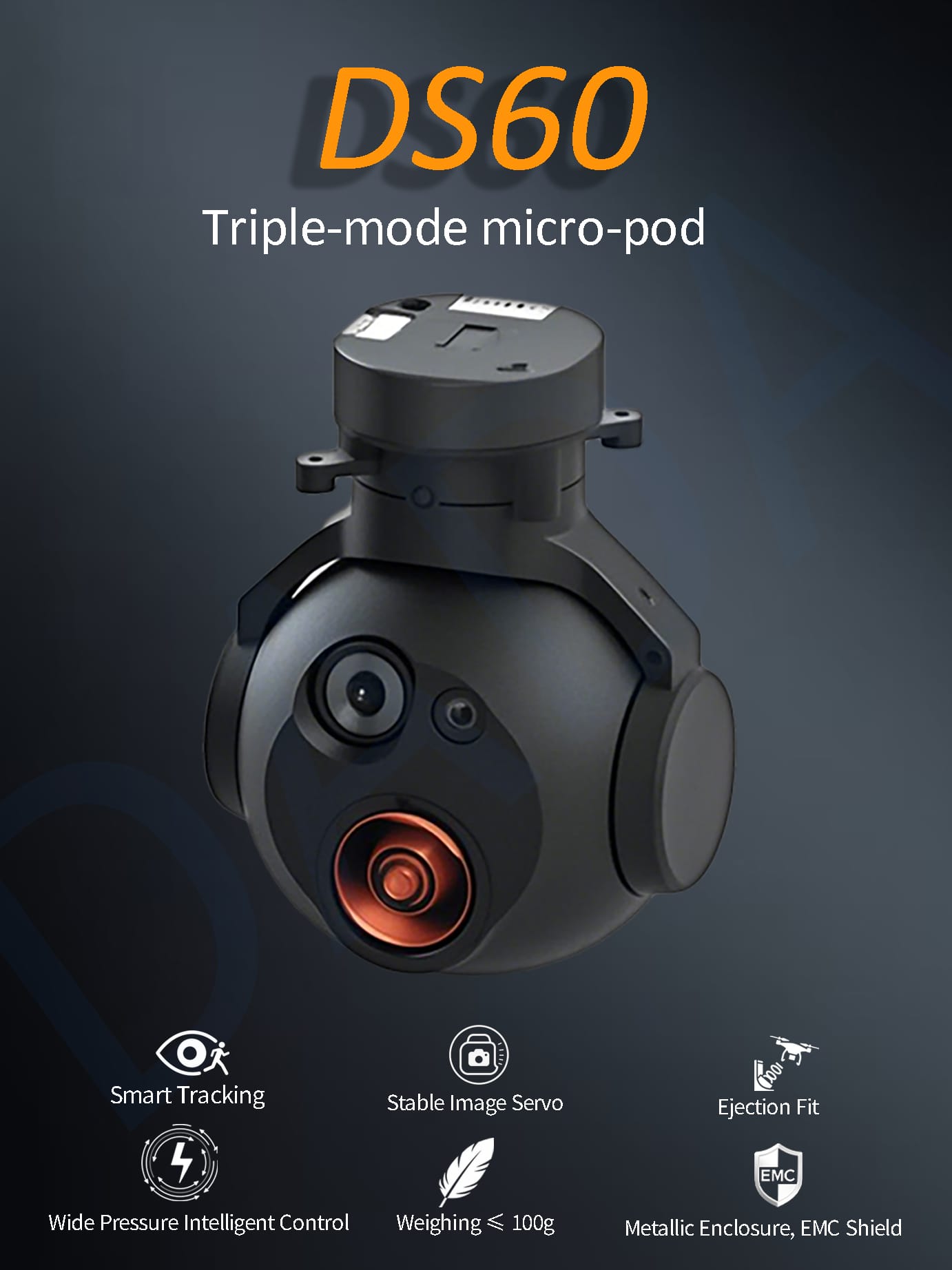
The DS60 Triple-mode Micro Pod combines dual visible-light cameras, infrared thermal imaging, and real-time target tracking in a compact payload weighing no more than 100 grams. Specifically, its large-field and small-field visible channels provide two useful perspectives at 1920×1080 and 60 fps. Meanwhile, the 640×512 thermal sensor records at 50 fps for detailed heat-source observation. A two-axis, gyro-stabilized platform controls pitch and roll to reduce movement-related jitter. Therefore, operators can receive clearer imagery from drones, robotic systems, mobile platforms, and other motion-heavy installations. The pod also supports RS232 and TCP control, while RTSP provides network-based video output. Moreover, its 12–28 V input range simplifies integration with different power systems. Average consumption remains at or below 10 W, with maximum consumption at or below 20 W. As a result, the unit balances imaging performance with the power limits of lightweight platforms. Additional protection comes from a metallic enclosure designed with EMC shielding principles. Together, these features make the pod suitable for surveillance, security monitoring, industrial observation, and search operations in low-visibility environments.
DS60 Triple-mode Micro Pod Technical Specifications
The specification profile shows how the pod combines several sensing functions without adding excessive payload weight. Notably, both electro-optic channels capture Full HD video at 60 fps. However, they use different lenses and fields of view. The large camera provides an 82°×52° view with a 3.2 mm lens. In contrast, the small camera offers a narrower 19.7°×11° view with a 16 mm lens. Therefore, operators can use a broader perspective for awareness and a tighter perspective for observing distant subjects.
Payload weight
Thermal resolution
Visible resolution
Maximum angular velocity
Supply voltage
Average power consumption
| Parameter | Specification |
|---|---|
| System and platform | Gyro stability; two-axial platform |
| Weight | ≤100 g |
| Large visible-light camera | 1920×1080 at 60 fps; 82°×52° FOV; 3.2 mm lens |
| Small visible-light camera | 1920×1080 at 60 fps; 19.7°×11° FOV; 16 mm lens |
| Thermal infrared camera | 640×512 at 50 fps; 32.9°×26.6° FOV; 13 mm lens |
| Pitch and roll | Pitch: -110° to +110°; roll: -100° to +40° |
| Maximum angular velocity | ≥100°/s |
| Stability accuracy | 0.1 mrad (0.1°/2 Hz), 1σ |
| Motor encoder accuracy | ≤0.3 |
| Target tracking speed | ≥40°/s |
| Control and video | RS232/TCP control; network RTSP video output |
| Electrical requirements | 12–28 V; average ≤10 W; maximum ≤20 W |
| Temperature range | Operating and storage: -20°C to +60°C |
| Launch impact | ≥100 g |
Integration Note
Mechanical drawings list an overall height of 64.51 and a body width of 47. They also show four M2, 6H mounting holes. However, the measurement unit is not explicitly printed in the extracted drawing data. Therefore, integrators should confirm every mechanical dimension before preparing brackets or airframe cutouts.
Dual Visible Cameras and 640 Thermal Imaging
The front face contains three optical modules within a rounded, dark metallic enclosure. Two smaller visible-light lenses sit near the top. Below them, a larger copper-colored thermal module handles infrared observation. Consequently, the physical layout keeps all three imaging channels together on one stabilized platform.
The two visible channels serve different viewing requirements. Firstly, the large-field camera helps operators survey roads, buildings, vehicles, and groups of people. Secondly, the small-field camera provides a tighter view for closer examination. Both channels deliver 1920×1080 video at 60 fps. Therefore, motion can appear fluid while operators switch between broad awareness and focused observation.
Meanwhile, the infrared channel records 640×512 thermal imaging at 50 fps. Its 32.9°×26.6° field of view supports heat-source observation across buildings and outdoor environments. In addition, dual-light thermal capture combines visible details with temperature information. As a result, image fusion can retain recognizable object shapes and colors while indicating heat-source locations.
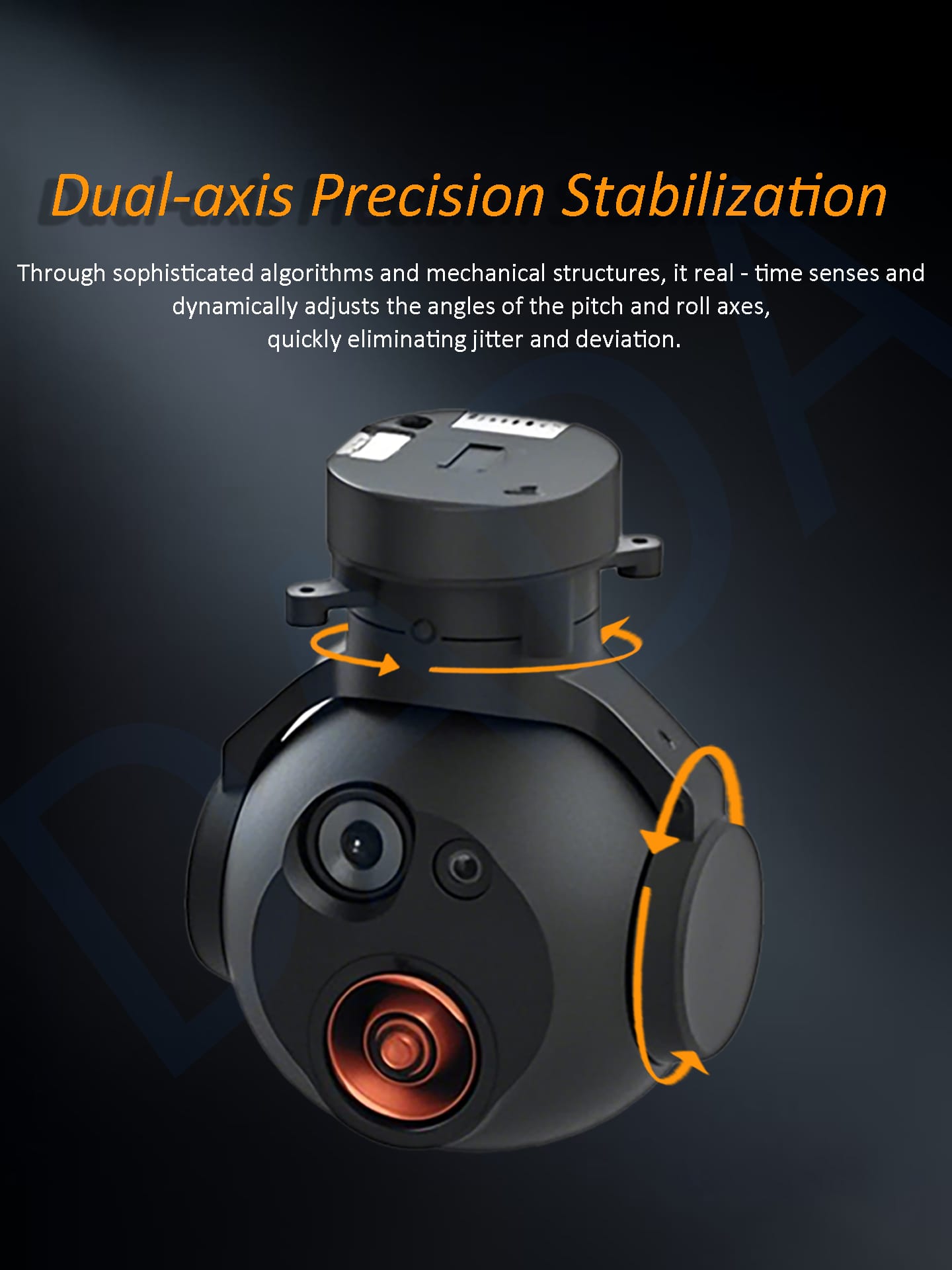
Visible imagery provides environmental context, while thermal imaging identifies temperature differences. Accordingly, operators receive complementary information rather than relying on one imaging spectrum alone.
Real-Time Target Tracking for People and Vehicles
Built-in target tracking allows the pod to lock onto and follow selected subjects in real time. Specifically, the product examples show tracking of personnel in crowded outdoor areas and vehicles traveling on roads. The listed tracking speed reaches at least 40° per second. Therefore, the system can respond to moving subjects while maintaining an active observation window.
Changing light can make manual observation more difficult. However, the combination of visible and infrared channels gives operators more information across varied conditions. Moreover, automated tracking can reduce the need for constant manual framing. It does not replace operational judgment, but it can simplify sustained monitoring of a selected target.
- Personnel tracking: Follow selected people through busy outdoor scenes.
- Vehicle tracking: Maintain observation of vehicles moving along roads.
- Dynamic response: Support target movement at tracking speeds of ≥40°/s.
- Dual-light context: Combine visible features with thermal heat-source information.
Two-Axis Stabilization and Wide-Angle Control
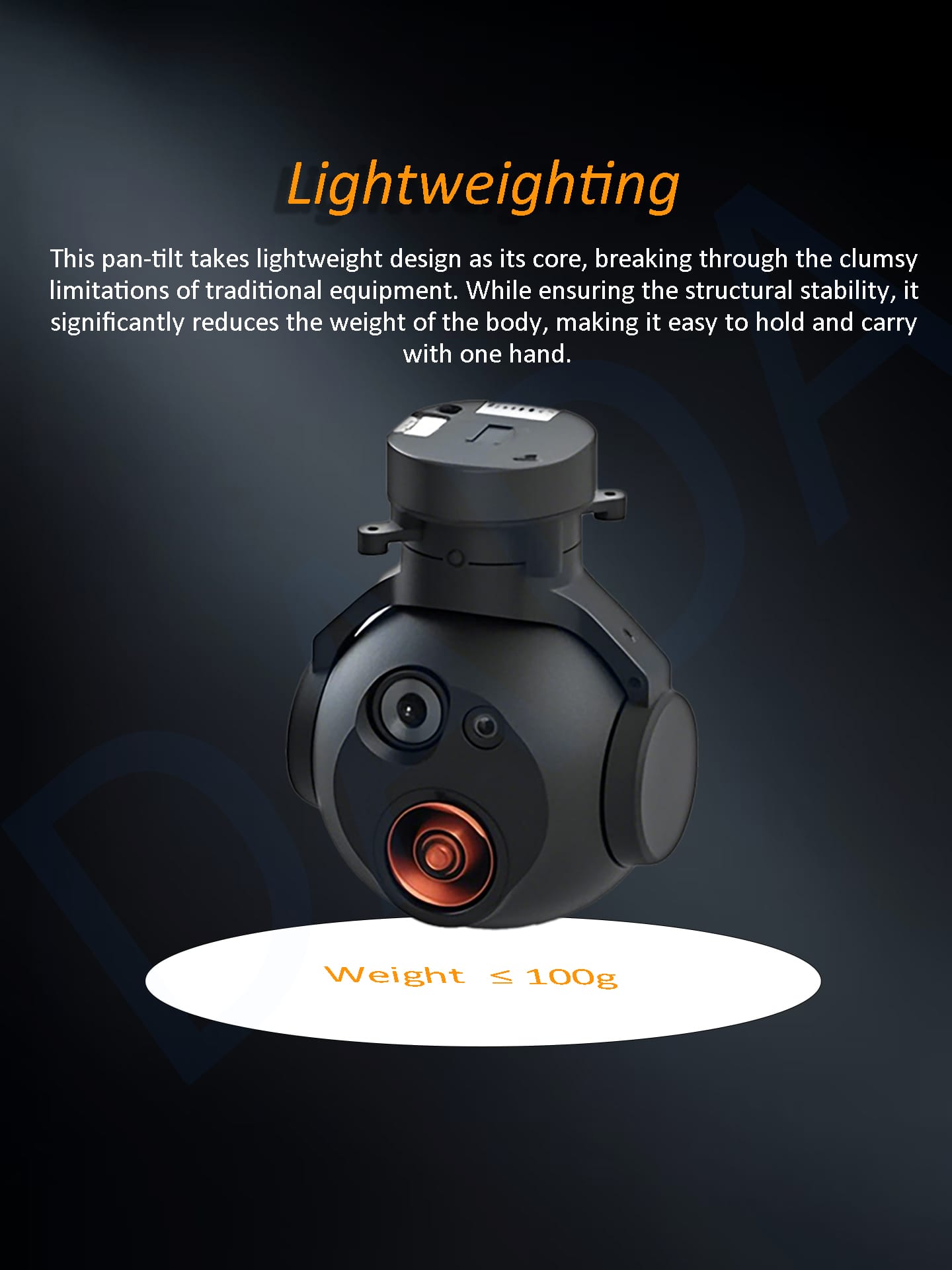
Mobile payloads face vibration, rapid directional changes, and platform movement. Therefore, the DS60 uses gyro stability with dynamic pitch and roll adjustments. Its servo stabilization function counters movement-related deviation and helps maintain usable imagery. Notably, the platform provides 0.1 mrad stability accuracy under the listed test condition.
The pitch axis moves from -110° to +110°, while the roll axis moves from -100° to +40°. In addition, maximum angular velocity reaches at least 100° per second. This range allows the imaging body to reposition quickly when a host platform changes direction. Consequently, the pod can support aerial surveillance, robotic inspection, and other movement-heavy applications.
Why Stabilization Matters
A high-resolution sensor cannot deliver its full value when platform vibration dominates the image. Thus, two-axis stabilization supports clearer observation while the host vehicle or aircraft remains in motion.
Power, Connectivity, and Environmental Design
A wide 12–28 V supply range gives integrators flexibility when pairing the payload with different platforms. Furthermore, average consumption remains at or below 10 W. Maximum consumption is listed at or below 20 W. As a result, the unit can suit battery-powered systems where payload efficiency is important.
For control, the pod supports RS232 and TCP interfaces. Network video is available through RTSP. Therefore, developers can connect control commands and live video with compatible onboard computers or ground systems. However, final compatibility should always be confirmed against the intended controller, network configuration, and software stack.
The specified operating and storage range extends from -20°C to +60°C. In addition, the electronics use metal-case packaging designed around EMC requirements. The metallic enclosure helps protect the integrated electronics from external interference. Notably, product materials also describe the pod as suitable for ejection-fit applications and list launch impact resistance of at least 100 g.
Practical Deployment Scenarios
The DS60 Triple-mode Micro Pod supports tasks that require compact sensing, stabilized video, and automated tracking. For instance, security teams can observe critical infrastructure, outdoor zones, or high-traffic areas. Meanwhile, search teams can use thermal imaging to look for heat signatures in low-visibility conditions.
- Surveillance and security: Monitor facilities, roads, public areas, and critical infrastructure.
- Search operations: Observe heat sources when visible-light detail is limited.
- Autonomous platforms: Supply environmental imagery and target tracking to drones or robotic systems.
- Industrial monitoring: Inspect warehouses, factories, buildings, and temperature-sensitive equipment.
- Mobile observation: Maintain stabilized imagery during platform vibration and directional movement.
However, deployment requirements vary by platform and mission. Therefore, buyers should review mounting geometry, interface compatibility, power availability, and environmental limits before integration.
Key Reasons to Consider the DS60
- Compact payload: The complete unit weighs no more than 100 g.
- Triple-mode sensing: Dual visible cameras, infrared thermal imaging, and tracking share one platform.
- Flexible observation: Large and small visible-light fields of view cover different viewing needs.
- Stable output: Gyro-assisted two-axis control reduces jitter during movement.
- Fast positioning: Angular velocity reaches at least 100°/s.
- Integration support: RS232/TCP control and RTSP video simplify compatible system connections.
- Efficient operation: Average power consumption is no more than 10 W.
- Environmental range: Operation is specified from -20°C to +60°C.
In conclusion, the pod brings several imaging and control functions into one lightweight enclosure. Consequently, it offers a practical option for integrators who need multi-spectrum observation without a large payload penalty.
Get in Touch
Contact us for pricing, integration guidance, detailed drawings, or help evaluating your surveillance requirements.
Website
Product Page
Phone (WhatsApp)
Related Posts
-
DA60N Mini Infrared UAV Pod: 200g Thermal Camera Payload for Catapult Drones
-
DT30DL Multi-Sensor Dual-Field EO/IR Laser Rangefinder Gimbal for Drone Surveillance
-
DS30E EO/IR Gimbal: Triple-Sensor Thermal Drone Camera with Laser Rangefinder & AI Tracking
-
DD360Pro Micro Gimbal Pod: Professional Triple-Mode EO/IR Payload for UAVs