DA0T1 High-Speed Seeker: 120 fps Electro-Optical Seeker with AI Target Tracking
Inside the DA0T1: A High-Speed Seeker Built for Aerial Pursuit
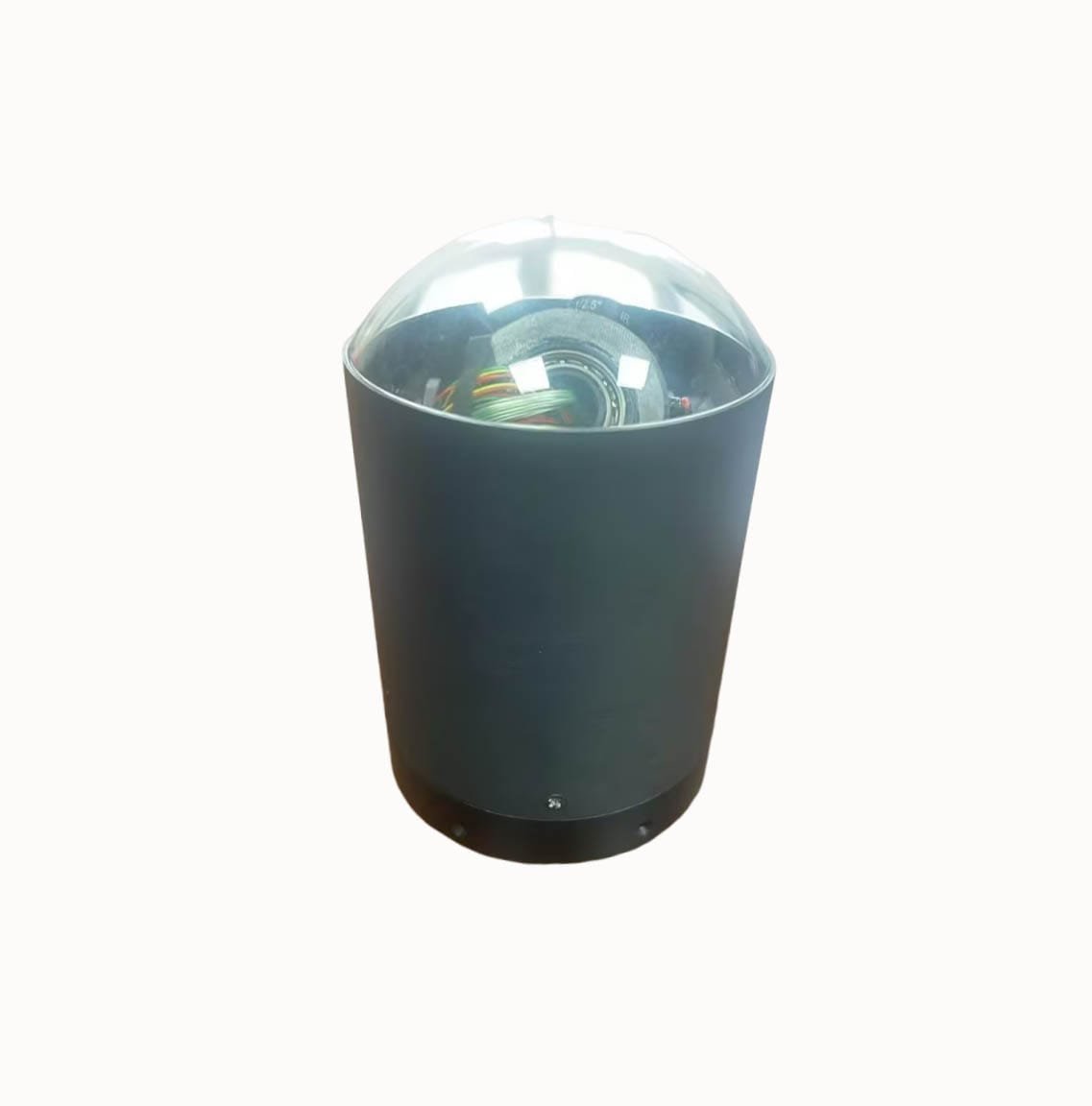
Locking onto a fast-moving aircraft is one of the hardest problems in aerial imaging. Ordinary 30 fps drone tracking cameras, however, simply cannot keep pace. The DA0T1 high-speed seeker answers that challenge with a 1280×720 monochrome CMOS sensor. Running at 120 frames per second, it keeps fast targets smooth and smear-free on screen. As a compact electro-optical seeker, it weighs no more than 180 g and measures roughly Φ70×85 mm. Therefore, the unit slips onto interceptor drones without eating into payload budgets. Moreover, an integrated 6T edge AI module performs AI target tracking entirely onboard. Specifically, it detects people, vehicles, and drones within 50 ms. As a result, pursuit platforms no longer wait for a ground station to classify and confirm a target. Meanwhile, the two-axis servo gimbal holds the line of sight steady through hard maneuvers. Likewise, 4× digital zoom brings small or distant aircraft into clearer view. In clear weather with 8 km visibility, the seeker tracks a 0.4×0.4 m drone from at least 320 m. Larger 2×2 m platforms remain trackable at up to 1,500 m. In short, this high-speed seeker turns the most demanding pursuit missions into a stable, automated workflow. The same architecture also supports low-altitude surveillance, public-security patrol, and environmental monitoring.
120 fps Imaging Meets 6T Edge AI Target Tracking
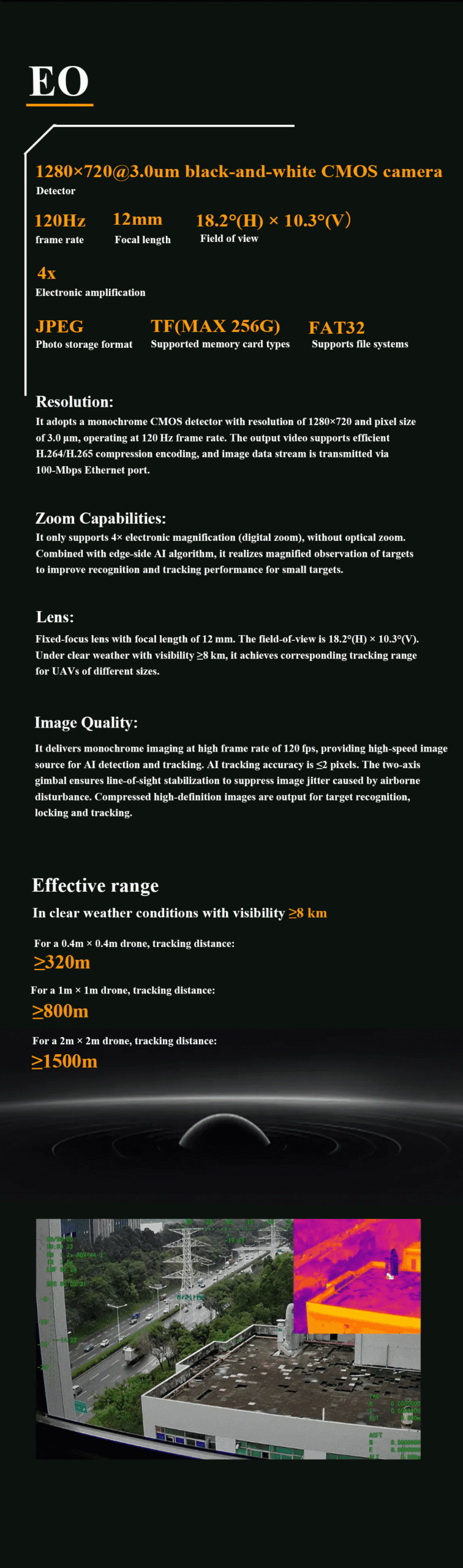
At the core of the DA0T1 high-speed seeker sits a 3.0 μm monochrome CMOS sensor behind a 12 mm fixed-focus lens. The field of view spans 18.2° horizontally and 10.3° vertically. Because the sensor outputs 120 fps, this high frame rate camera freezes motion that would smear on a 30 fps stream. Consequently, the tracking algorithm stays locked at up to 120 frames per second with an accuracy of ≤2 pixels. Furthermore, the 6T edge AI computing module drives AI target tracking with zero dependence on ground hardware. Specifically, it recognizes people, vehicles, and drones in 50 ms or less. That speed leaves an autopilot enough time to react when milliseconds decide the outcome. For instance, an interceptor drone payload carrying this seeker can acquire a small quadcopter and confirm its classification. At the same time, guidance steers the intercept while the tracker keeps the target centered. In addition, two-axis servo stabilization suppresses airframe vibration across ±30° of yaw and ±50° of pitch. Additionally, picture-in-picture display and rich OSD overlays stream camera status, target coordinates, and platform attitude to the operator. Notably, 4× digital zoom combined with AI recognition keeps small or distant targets classifiable with confidence. Together, these functions turn the electro-optical seeker into a drone tracking camera engineered for the fastest phase of an engagement.
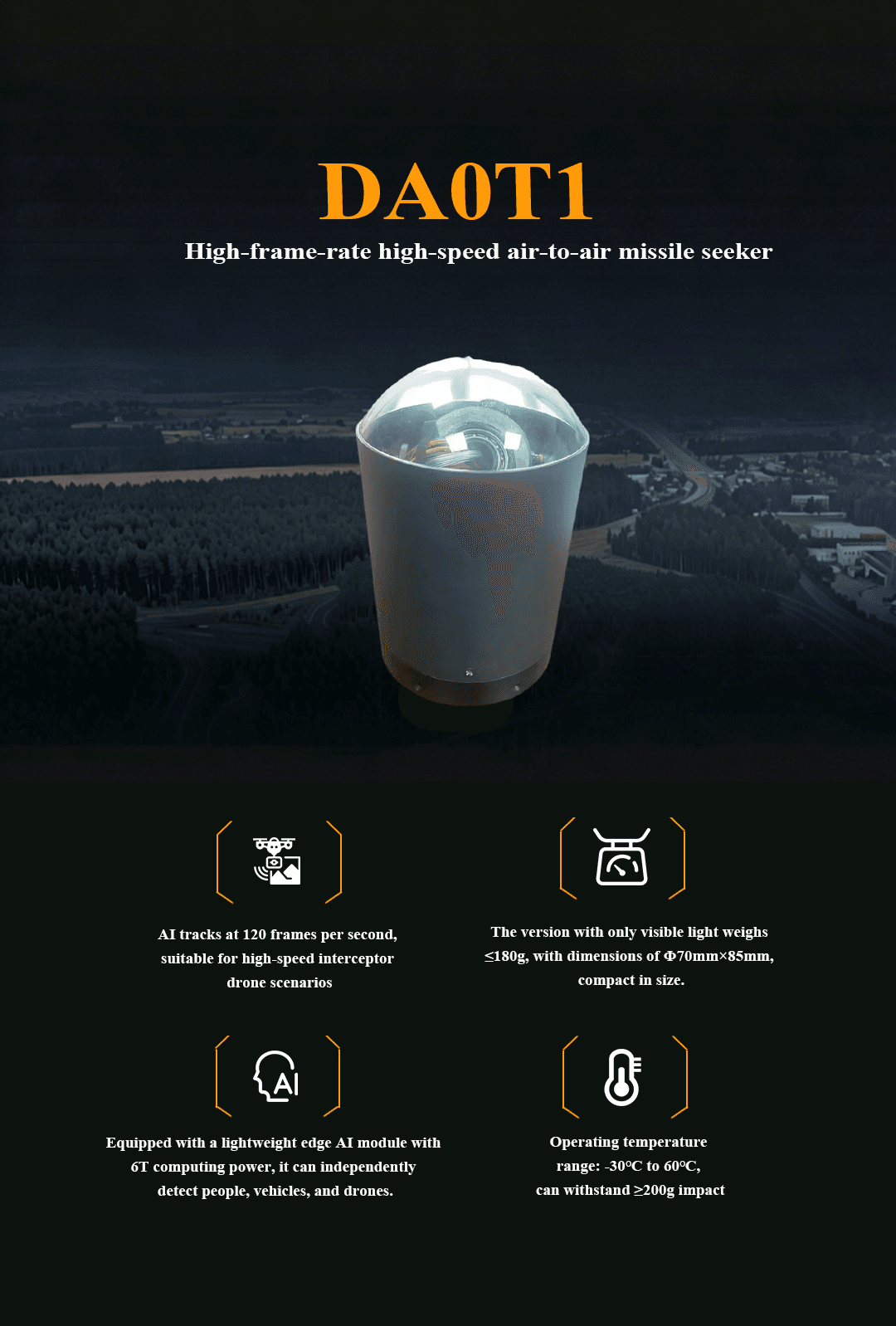
Official overview of the DA0T1 electro-optical seeker and its onboard AI target tracking architecture.
High-Speed Seeker Engineering: Lightweight, Rugged, and Integration-Ready
Airborne hardware only matters if it survives the flight. Therefore, the DA0T1 high-speed seeker is built around a compact cylindrical body that weighs 180 g or less. In addition, it operates from -30°C to +60°C and withstands 200 g mechanical shock. Light to moderate rain poses no problem either. That durability covers hard launches, rapid altitude changes, and damp field conditions. Integration is deliberately straightforward. Specifically, the seeker exposes one 100 Mbps Ethernet channel plus an RS-TTL UART at 230400 bps. Power arrives over 12–28 V DC, with average consumption below 10 W. Meanwhile, a TF card slot supports up to 256 GB of FAT32 storage for H.264/H.265 video and JPEG stills. As a result, post-flight analysis stays simple. Moreover, stabilization accuracy remains within 0.5° despite the compact footprint. Gimbal travel spans ±30° in yaw and ±50° in pitch. Consequently, this high-speed seeker slots naturally into interceptor drones, low-altitude counter-UAV surveillance, public-security patrol, and forest-fire monitoring missions. Law-enforcement teams also deploy this drone tracking camera for remote monitoring and evidence-grade observation. In other words, one 180-gram electro-optical seeker covers pursuit, patrol, and inspection roles. The table below summarizes why engineering teams keep specifying this high-speed seeker.
Drone tracking ranges (clear weather, visibility ≥8 km): 0.4×0.4 m targets tracked at ≥320 m, 1×1 m targets at ≥800 m, and 2×2 m platforms at ≥1,500 m. The DA0T1 high-speed seeker sustains this AI target tracking performance at 120 fps with ≤2 px accuracy.
| Parameter | Specification |
|---|---|
| Product Model | DA0T1 |
| Product Type | High-frame-rate high-speed electro-optical seeker |
| Weight | ≤180 g (visible-light version) |
| Dimensions | Approx. Φ70 × 85 mm |
| Imaging Sensor | 1280 × 720 monochrome CMOS, 3.0 μm pixels |
| Frame Rate | 120 fps |
| Lens / Field of View | 12 mm fixed focus; 18.2° (H) × 10.3° (V) |
| Digital Zoom | 4× electronic zoom |
| AI Computing Power | 6T edge AI |
| AI Detection Targets | People, vehicles, drones |
| AI Detection Time | ≤50 ms |
| Tracking Speed / Accuracy | 120 fps / ≤2 pixels |
| Drone Tracking Distance | ≥320 m (0.4×0.4 m), ≥800 m (1×1 m), ≥1500 m (2×2 m) |
| Test Condition | Clear weather, visibility ≥8 km |
| Stabilization | Two-axis servo gimbal; ≤0.5° accuracy; yaw ±30°, pitch ±50° |
| Interfaces | 1× 100 Mbps Ethernet; 1× RS-TTL UART (230400 bps) |
| Power | 12–28 V DC; ≤10 W average |
| Storage | TF card up to 256 GB (FAT32); H.264/H.265 video; JPEG photos |
| Environment | -30°C to +60°C; ≥200 g shock; light to moderate rain |
Reference sheet for the DA0T1 drone tracking camera seeker, showing the Φ70×85 mm housing and full parameter list.
Related links
website
Product
https://uavauto.com/product/da0t1-high-frame-rate-high-speed-seeker/