
DC3 Target Tracking Gimbal: 69 g FHD Imaging for Compact UAVs
Compact Imaging, Stable Tracking, and Lightweight Integration
The DC3 target tracking gimbal gives compact aircraft and robotic platforms a lightweight visible-light imaging option. At only 69 grams, it combines an FHD EO camera, three-axis stabilization, and automated tracking in one small assembly. Moreover, the camera records 1920 × 1080 video at 50 fps. This frame rate supports smooth observation of vehicles, infrastructure, and other moving subjects. The micro UAV gimbal also provides 10× optical zoom for clear magnification. In addition, 40× hybrid zoom extends its observation range when more detail is needed. Its tracking capability reaches at least 100° per second, helping the camera follow fast movement with less manual correction. Meanwhile, gyro stabilization manages yaw, pitch, and roll movement to reduce vibration in the video. The DC3 supports UDP and RTSP streaming, H.264 or H.265 encoding, and MP4 recording. Therefore, integrators can connect it to established video and storage workflows. RS232 and network control provide flexible command options, while a 12–28 V DC input suits varied platform designs. As a result, the DC3 is a practical choice for UAV inspection, robotic observation, security patrols, and environmental monitoring.
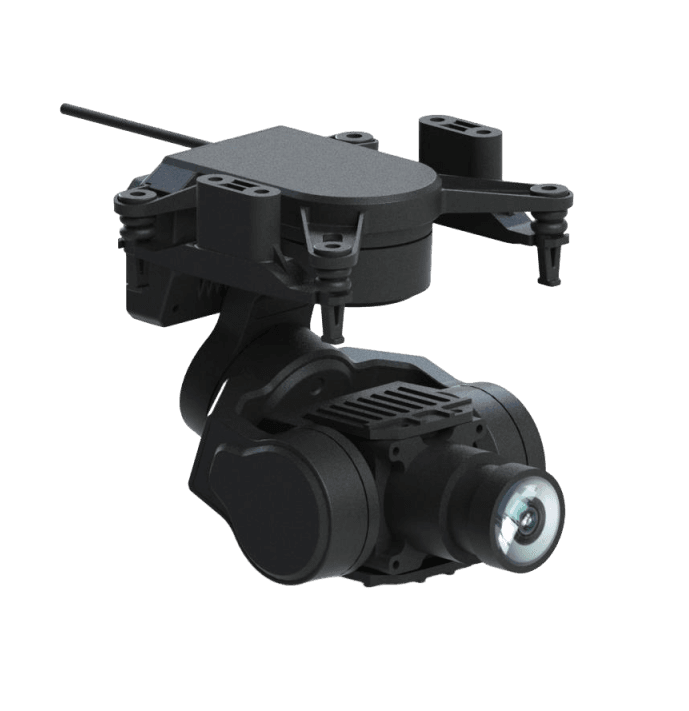
DC3 Target Tracking Gimbal Specifications
The DC3 combines its main imaging, motion, and integration functions in a single compact platform. Notably, its 38.4° horizontal by 22.2° vertical field of view supports efficient scene scanning. Operators can then use optical or hybrid zoom for closer observation. The table below summarizes the confirmed specifications shown in the product information and technical imagery.
| Parameter | DC3 specification |
|---|---|
| Product class | Three-axis micro gimbal |
| Camera | Single visible-light FHD EO imaging camera |
| Weight | 69 g |
| Video | 1920 × 1080 at 50 fps |
| Field of view | 38.4° horizontal × 22.2° vertical |
| Zoom | 10× optical and 40× hybrid |
| Tracking capability | ≥100°/s |
| Stabilization accuracy | 0.1 mrad under 1°/2 Hz vibration, 1σ |
| Axis movement | Yaw ±150°; pitch −90° to +30°; roll ±45° |
| Video integration | UDP/RTSP, H.264/H.265, and MP4 |
| Control | RS232 or network |
| Power input | 12–28 V DC |
| Power consumption | Average ≤15 W; maximum ≤30 W |
| Operating temperature | −20°C to +55°C |
| Storage temperature | −20°C to +50°C |
| Mechanical interface | Four M2 threaded mounting holes, depth 7 |
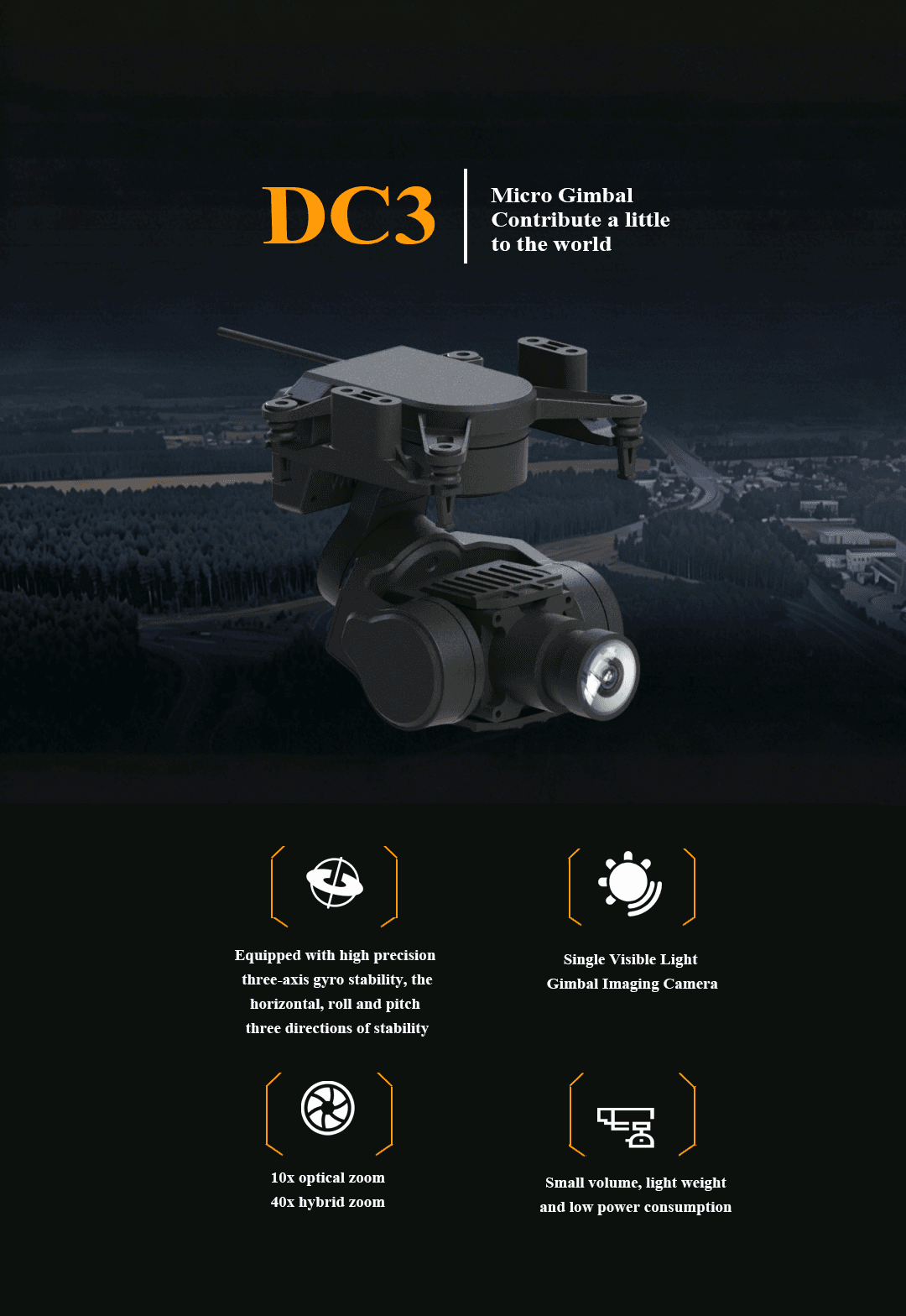
Integration highlight: The DC3 accepts 12–28 V DC power and supports RS232 or network control. Therefore, developers can connect it to many compact UAV and robotic architectures.
Full HD Imaging with 10× Optical Zoom
At the center of the system is a single visible-light FHD EO camera. It produces 1920 × 1080 video at 50 fps. Consequently, moving scenes can appear smoother and easier to assess. The higher frame rate can also reduce visible stutter during platform movement or rapid subject motion.
The 10× optical zoom enlarges distant subjects without relying only on digital processing. In addition, 40× hybrid zoom provides extra reach for detailed observation. Operators can begin with the wider field of view and then narrow the scene. Therefore, the camera supports both broad scanning and focused inspection from one platform.
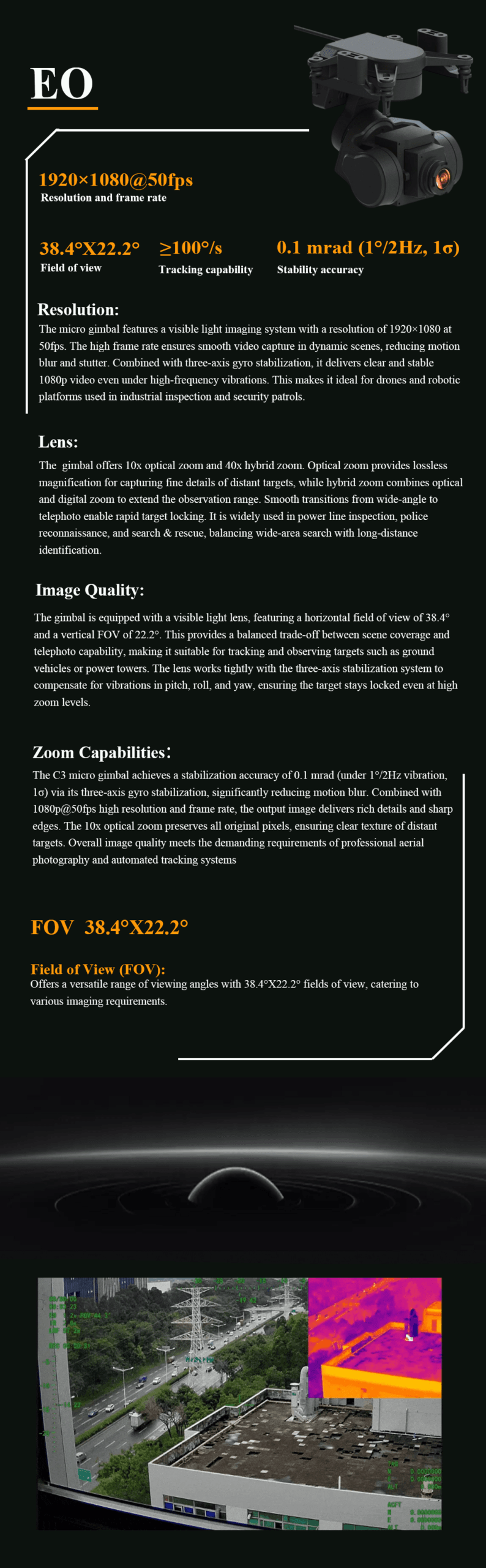
Picture-in-picture capability can place a secondary view within the primary display. Moreover, the rich OSD can show camera, target, and platform information. Example interface elements include tracking status, zoom level, recording state, coordinates, altitude, heading, and pitch scales. However, sample interface values should not be treated as fixed technical specifications.
Three-Axis Stabilization and Automated Tracking
Aerial and robotic platforms regularly encounter vibration, turns, and abrupt attitude changes. However, the DC3 uses gyro stabilization across yaw, pitch, and roll. This three-axis system helps the micro UAV gimbal maintain more usable visible-light footage during movement.
The yaw axis rotates through ±150°, while the roll axis reaches ±45°. Similarly, the pitch axis moves from −90° to +30°. These ranges support forward observation, downward inspection, and lateral tracking. Notably, the specified stabilization accuracy is 0.1 mrad under the stated 1°/2 Hz vibration condition at 1σ.
The tracking system supports angular movement of at least 100° per second. Therefore, the DC3 target tracking gimbal can respond to moving ground vehicles and other dynamic subjects. Automated tracking also reduces repeated manual adjustments. As a result, operators can concentrate more closely on mission decisions.
Operational benefit: Stabilization helps preserve a clear viewing angle. Meanwhile, automated tracking helps keep the selected subject centered during movement.
Streaming, Recording, and Mechanical Integration
The DC3 supports UDP and RTSP output for live network video. Moreover, H.264 and H.265 encoding offer familiar options for bandwidth and storage planning. MP4 recording provides a convenient format for reviewing footage after a mission. Therefore, the FHD EO camera can fit into established monitoring workflows.
Control is available through RS232 or a network connection. In addition, average power use is 15 W or less. Maximum consumption is listed at 30 W or less. Accordingly, engineers can evaluate battery capacity and electrical margins before installation.
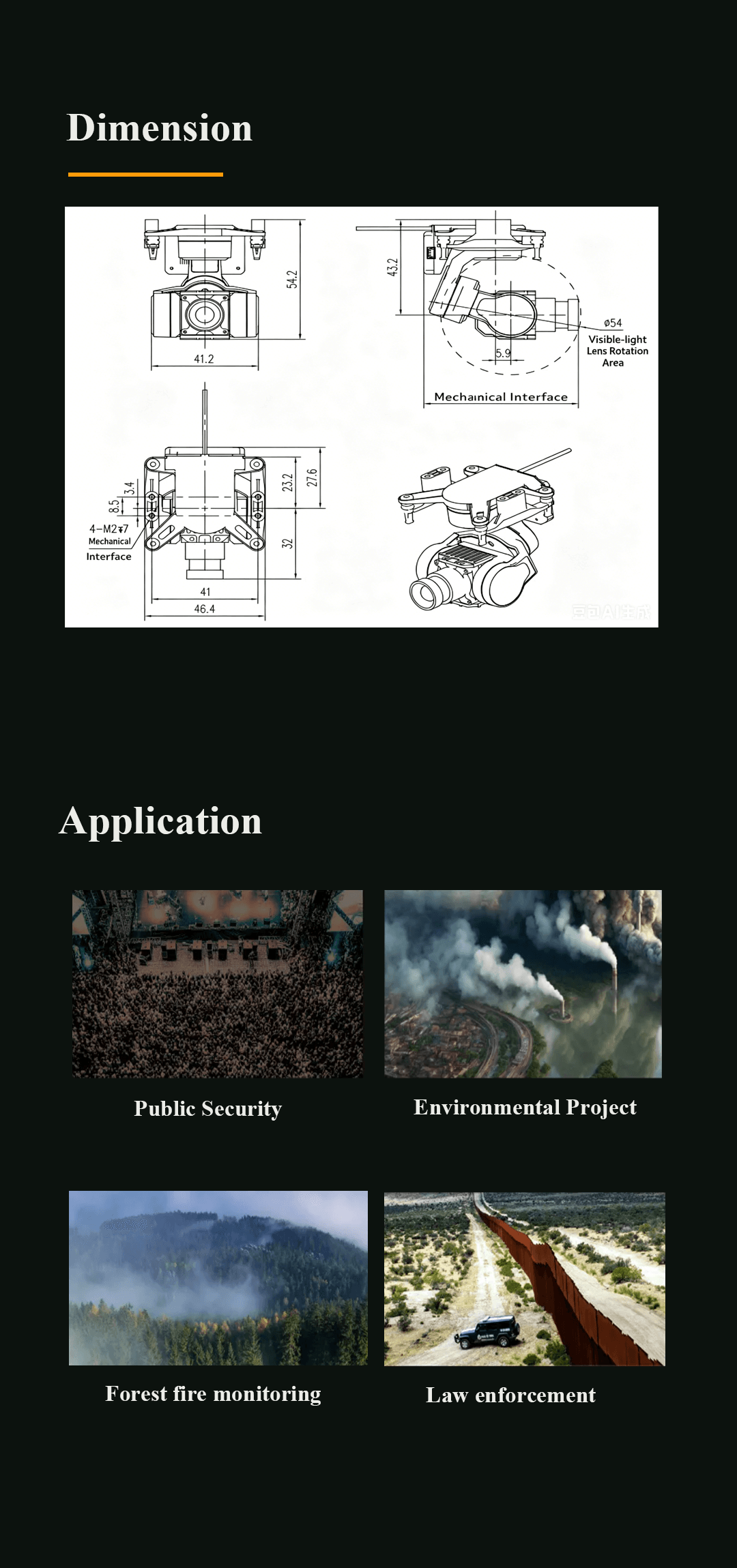
The technical drawing shows front, side, bottom, and isometric views. It also identifies four M2 threaded mounting holes with a depth of 7. Furthermore, the visible-light lens rotation envelope is marked Ø54. Other drawing callouts include 41.2, 54.2, 43.2, 46.4, 41, and several smaller values. However, the drawing does not explicitly state a measurement unit. Integrators should therefore confirm every dimension and rotation clearance before final installation.
The product is confirmed as a single visible-light EO camera gimbal. Some promotional panels contain references to other models or sensor configurations. Consequently, triple-sensor, thermal, laser-ranging, and day-night claims should not be assigned to the DC3 without manufacturer confirmation.
Practical UAV and Robotic Applications
The compact DC3 supports missions that require stabilized visible-light observation without a heavy payload. For instance, it can provide zoom imagery during industrial or power-line inspection. Similarly, security teams can use the DC3 target tracking gimbal for patrol and perimeter monitoring.
- Industrial inspection: Observe structures, power towers, and difficult locations from a compact UAV.
- Public security: Support patrols, perimeter observation, and moving-target monitoring.
- Search and rescue: Scan broad areas before zooming toward subjects or points of interest.
- Environmental monitoring: Collect stabilized Full HD footage from remote areas.
- Forest-fire monitoring: Observe prevention zones from safer aerial or robotic positions.
- Ground robotics: Add stabilized imaging and network video to compact unmanned vehicles.
Ultimately, the DC3 balances low weight, optical reach, and stable imaging. Its standard network outputs also simplify video distribution. Meanwhile, automated tracking can reduce the operator’s workload during dynamic missions. Thus, this micro UAV gimbal is well suited to weight-sensitive aerial and robotic systems.
Related links
website
product-link
https://uavauto.com/product/dc3-fhd-eo-camera-3-axis-micro-uav-gimbal-for-target-tracking/
Phone
Related Posts
-
DA0T1 High-Speed Seeker: 120 fps Electro-Optical Seeker with AI Target Tracking
-
DA531 EO/IR Gimbal: Lightweight Three-Axis UAV Gimbal Camera with Thermal Imaging
-

UAV Camera Selection Guide – How to Choose Camera Modules for Drone Payloads
-
Aurora Mini DSQ09 Thermal Core Module: Compact 640×512 OEM Imaging