
DX5A UAV Gimbal Payload for 4K EO and Dual IR Surveillance
A Closer Look at Five-Channel Aerial Imaging
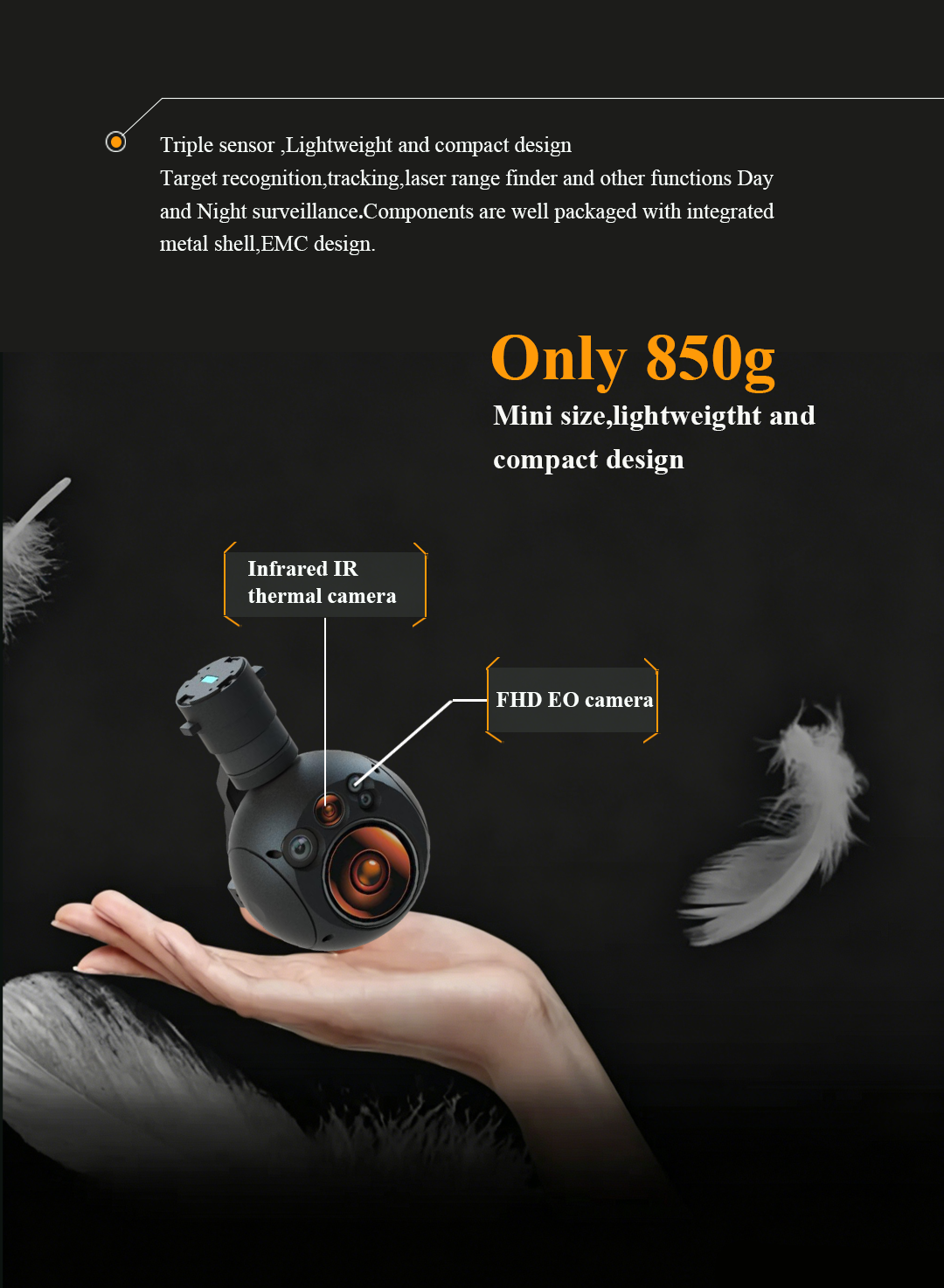
The DX5A UAV gimbal payload combines visible-light observation, dual IR imaging, target tracking, and three-axis stabilization in one compact system. Specifically, it integrates three visible-light channels with two infrared channels for day-and-night aerial surveillance. Its dual 4K image sensors capture 3840 × 2160 video at 30 fps. Meanwhile, the dual thermal channels produce 640 × 512 imagery at 30 fps. This five-channel arrangement helps operators move from broad detection to detailed identification without changing payloads. Moreover, the integrated 4K EO camera provides 40× optical zoom and 120× hybrid zoom. It can cover a 100° × 68° wide field of view or narrow the view to 2.5° × 1.4° at telephoto. Therefore, teams can scan large areas and inspect distant subjects from the same platform. The thermal imaging payload adds wide and narrow IR views for flexible heat-signature observation. In addition, built-in recognition and tracking modes support the automatic identification and following of vehicles or people. The stabilized gimbal delivers angular position accuracy of ≤0.3° and stability accuracy of 0.1 mrad. Consequently, imagery remains useful while the aircraft turns, accelerates, or corrects its position. At 850 g, the DX5A also balances multi-sensor capability with practical UAV integration. Furthermore, its average power consumption is ≤15 W, reducing the electrical burden on compatible aircraft. Network video, H.264/H.265 encoding, MP4 recording, picture-in-picture viewing, and rich OSD overlays support live operational workflows. As a result, the system is well suited to public security, forest-fire monitoring, environmental observation, law enforcement, infrastructure inspection, and wide-area search.
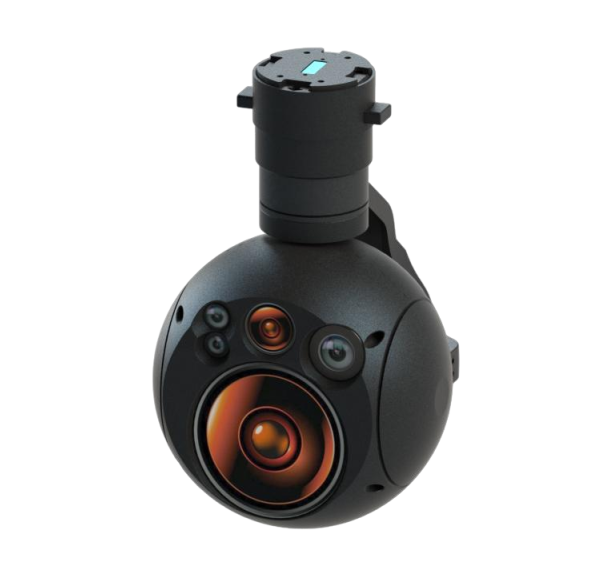
DX5A UAV Gimbal Payload Specifications
The DX5A is described as a triple-mode micro-pod with a five-channel sensor combination. Although those terms differ, the listed configuration remains clear: three visible-light channels and two infrared channels. Notably, the official product weight is 850 g. One separate IR graphic references a stabilized platform weighing ≤700 g. However, that figure may refer to another platform configuration, so integrators should confirm final aircraft requirements before installation.
| Category | DX5A specification |
|---|---|
| Weight | 850 g |
| Sensor combination | Three visible-light channels and two IR channels |
| EO imaging | 3840 × 2160 at 30 fps; dual 4K image sensors |
| EO zoom | 40× optical and 120× hybrid |
| EO field of view | 100° × 68° wide; 2.5° × 1.4° telephoto |
| Thermal imaging | 640 × 512 at 30 fps |
| Thermal field of view | 33° × 26.6° with 13 mm lens; 8.5° × 6.8° with 52 mm lens |
| Position and stability | ≤0.3° angular accuracy; 0.1 mrad stability accuracy |
| Tracking capability | ≥60° per second |
| Gimbal movement | Continuous yaw; -90° to +30° pitch; ±45° roll |
| Video and storage | Network output, H.264/H.265 encoding, MP4 recording |
| Power | 12–24 V DC; average consumption ≤15 W |
| Temperature range | -20°C to +55°C operating; -20°C to +60°C storage |
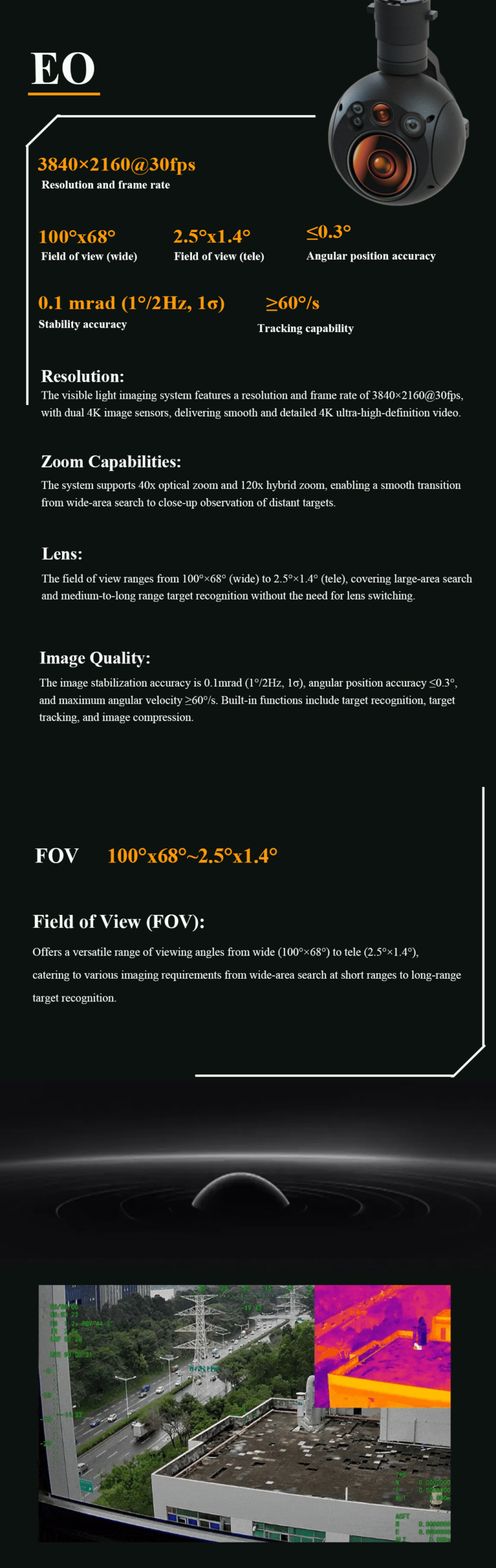
Wide-Area Search and Long-Range EO Observation
The 4K EO camera supports both rapid scanning and focused observation. Firstly, its 100° × 68° wide view helps crews examine roads, buildings, infrastructure, or broad terrain. Next, the 40× optical zoom narrows the scene for closer inspection. The 120× hybrid zoom then extends the available digital reach. However, environmental conditions and flight stability will still affect usable detail at extreme distances.
Meanwhile, the 2.5° × 1.4° telephoto field of view supports medium-to-long-range recognition. This capability can reduce the need to fly directly over a subject. Therefore, operators can maintain a wider observation position when mission procedures require it. The dual 4K sensors also provide detailed visible-light footage for live viewing and recorded analysis.
In addition, built-in target recognition helps identify vehicles and people through corresponding tracking modes. Once a subject is selected, the tracking function can follow movement at angular speeds of at least 60° per second. Consequently, the DX5A UAV gimbal payload can support dynamic public-safety observation, traffic monitoring, and wide-area search.
Dual IR Thermal Imaging for Day-and-Night Missions
The dual-channel thermal imaging payload gives operators two complementary IR perspectives. Specifically, the 13 mm thermal lens provides a 33° × 26.6° view for broad scanning. The 52 mm lens offers an 8.5° × 6.8° view for narrower observation. Both channels deliver 640 × 512 imagery at 30 fps.
Moreover, the available palettes include White Hot, Black Hot, Iron Red, Rainbow, and Fusion. Different infrared-module configurations may support between six and fifteen palette options. Therefore, crews can adjust the thermal display to suit the background and operational task. Temperature-bar overlays can also be displayed or hidden as needed.
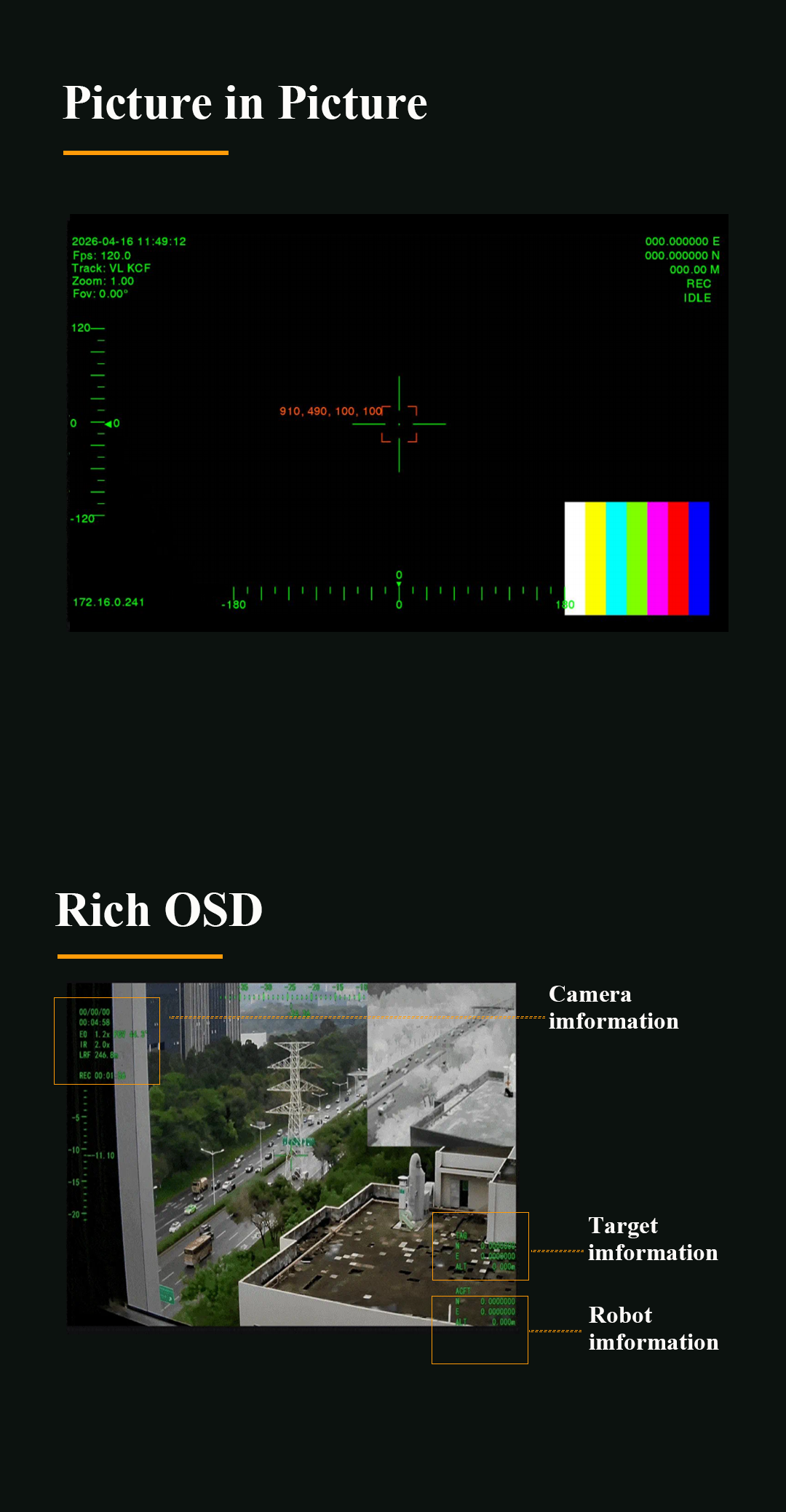
Picture-in-picture mode combines thermal and visible-light imagery on one screen. For instance, the interface can place a thermal window over the main EO feed. As a result, operators can compare heat signatures with recognizable visual details. Rich OSD options can also show camera data, target information, aircraft information, recording status, zoom, and field of view.
Three-Axis Stabilization and Target Tracking
A capable sensor package still requires stable pointing. Therefore, the DX5A uses a three-axis gimbal with continuous yaw rotation. Pitch movement spans -90° to +30°, while roll movement reaches ±45°. The roll axis also helps maintain a level horizon during aircraft maneuvers.
Furthermore, angular position accuracy is specified at ≤0.3°. Stability accuracy is rated at 0.1 mrad under the stated test condition. Consequently, the 4K EO camera and thermal channels can hold a steadier view while the UAV changes direction. This stabilization is valuable for target tracking, inspection, mapping support, and recorded evidence.
The system supports RS232/TCP control and TTL-level serial communication. Product information also identifies UART with 3.3 V TTL and RS232 protocol, with SBUS available as an option. Accordingly, integration teams can select a control method suited to the aircraft and ground-control architecture.
Compact Housing and UAV Integration
Visually, the DX5A UAV gimbal payload has a compact matte-black spherical body and a cylindrical upper mount. Its front face places a large optical aperture beneath several smaller sensor openings. Additionally, orange and amber lens coatings give the primary apertures a distinctive appearance. Rounded side housings form the rotating gimbal structure.
The metal enclosure surrounds the electronic components. According to the product graphics, this construction supports protection strength, electromagnetic shielding, and heat dissipation. Moreover, the engineering drawing identifies a quick-release structure and four M3 mounting holes. It lists an overall height of 172.6, front width of 109, and side depth of 117.30. However, the drawing does not state units, so installers should verify dimensions before designing an adapter.
Finally, the payload operates from -20°C to +55°C and stores from -20°C to +60°C. These ranges support deployment across varied working environments. Nevertheless, platform compatibility depends on payload capacity, electrical supply, mounting geometry, data interfaces, and local operating requirements.
Mission Applications
The thermal imaging payload is designed for missions that benefit from visible and infrared observation. For example, forest-fire teams can search for thermal anomalies while recording the surrounding scene. Similarly, public-security and law-enforcement teams can observe vehicles or people with supported recognition and tracking modes.
- Wide-area search: Scan broad terrain with the wide EO view before zooming toward a subject.
- Forest-fire monitoring: Combine thermal observations with detailed visible-light imagery.
- Public security: Support aerial patrol, observation, and target-following workflows.
- Environmental projects: Observe industrial sites, emissions, terrain, and infrastructure from the air.
- Road and traffic observation: Monitor moving vehicles using EO and thermal feeds.
- Infrastructure inspection: Review buildings, roads, and electrical assets from stabilized viewpoints.
In conclusion, the DX5A brings zoom imaging, dual thermal views, recognition, tracking, and stabilization into one integrated unit. Its network output and control interfaces also simplify connection to compatible UAV systems. Therefore, it offers a practical multi-band option for professional aerial observation.
Related links
website
product-link
Phone
Related Posts
-
DA60N Mini Infrared UAV Pod: 200g Thermal Camera Payload for Catapult Drones
-
DT30DL Multi-Sensor Dual-Field EO/IR Laser Rangefinder Gimbal for Drone Surveillance
-
DS30E EO/IR Gimbal: Triple-Sensor Thermal Drone Camera with Laser Rangefinder & AI Tracking
-
DD360Pro Micro Gimbal Pod: Professional Triple-Mode EO/IR Payload for UAVs