
DC1 Micro UAV Gimbal Camera: Lightweight FHD Zoom Imaging
Why the DC1 Stands Out
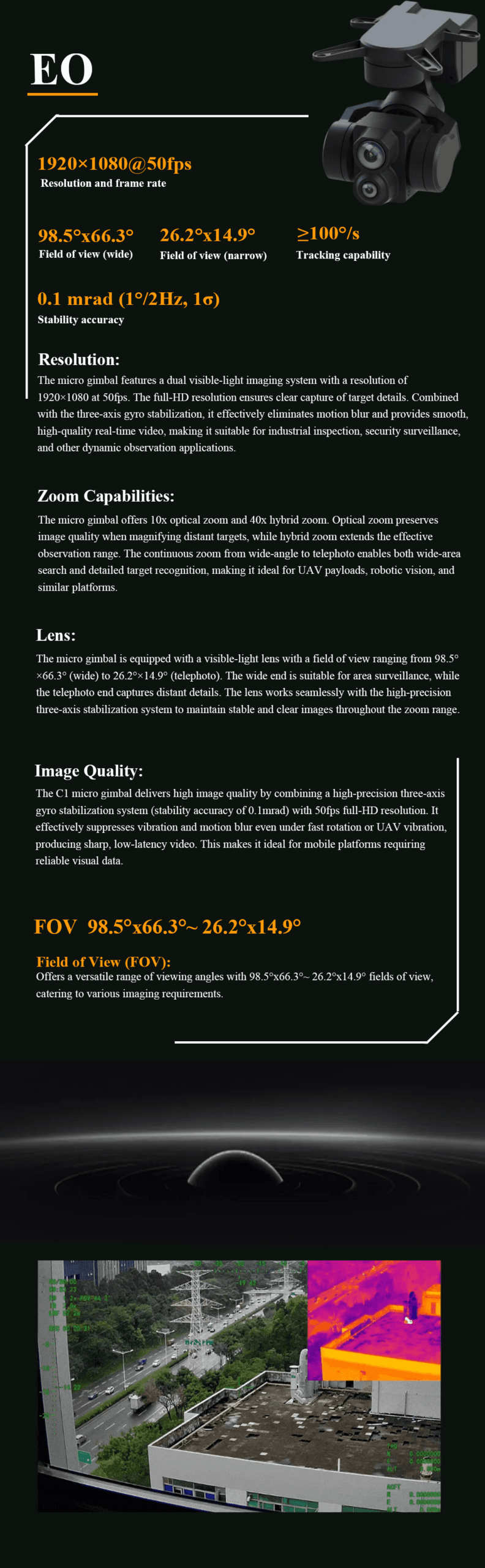
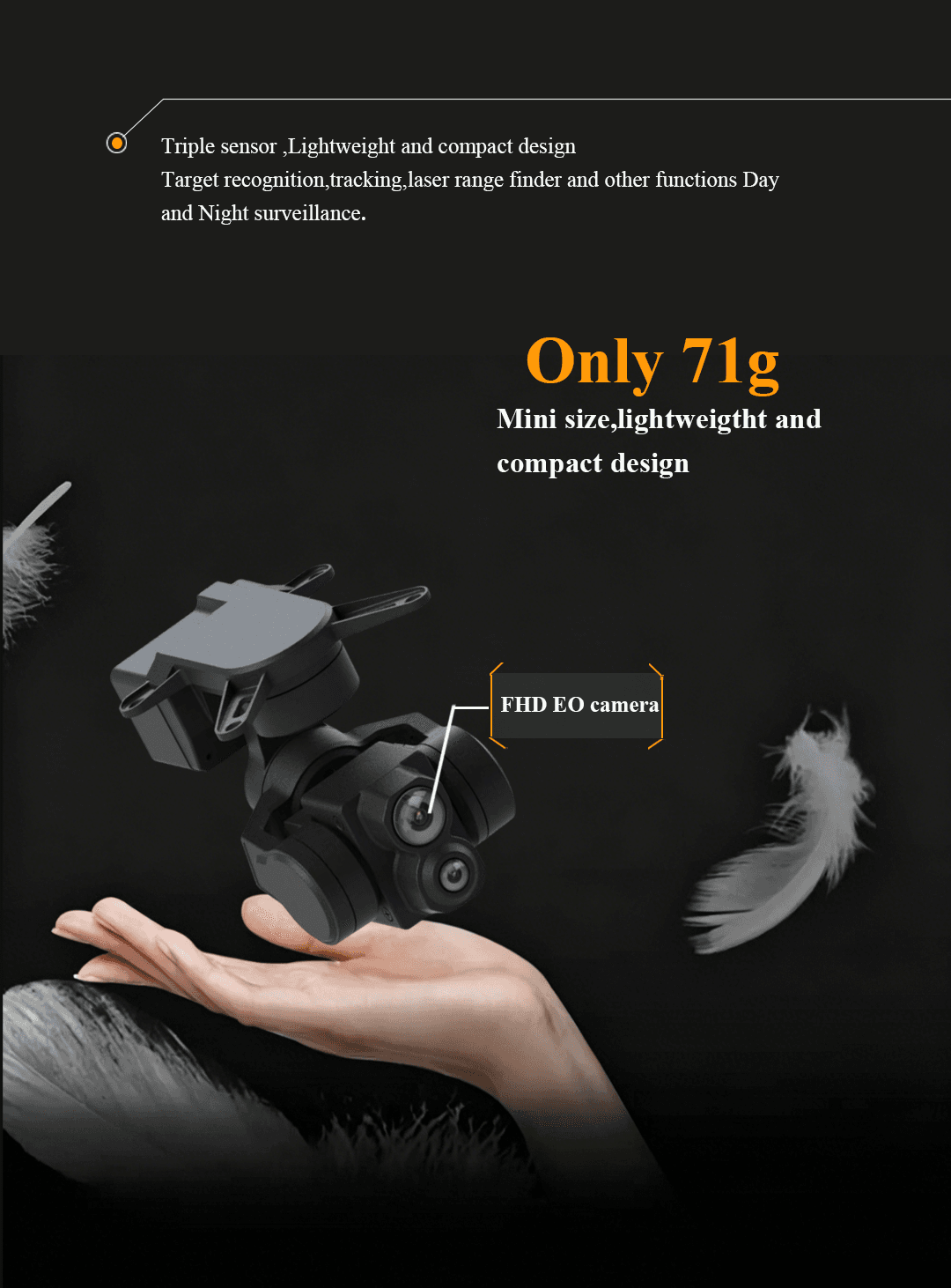
The DC1 micro UAV gimbal camera combines stabilized imaging, flexible zoom, and compact dimensions in a 71 g payload. Therefore, it gives small aerial and mobile platforms capable imaging without adding excessive weight. The dual visible-light imaging system includes an FHD EO camera that records 1920 × 1080 video at 50 fps. Moreover, 10× optical zoom and 40× hybrid zoom support both wide-area observation and distant target recognition. The field of view changes from 98.5° × 66.3° at the wide setting to 26.2° × 14.9° at telephoto. As a result, operators can scan a broad scene before examining a selected area more closely. The three-axis gimbal stabilizes yaw, roll, and pitch movement with 0.1 mrad accuracy under the stated test condition. In addition, its maximum angular velocity of at least 100°/s supports responsive observation from moving platforms. This UAV payload camera also offers picture-in-picture viewing, detailed OSD information, and UDP/RTSP network video. Meanwhile, RS232 and network control provide practical integration options for UAVs and robotic systems. These capabilities make the FHD EO camera suitable for security monitoring, industrial inspection, environmental projects, and forest-fire observation.
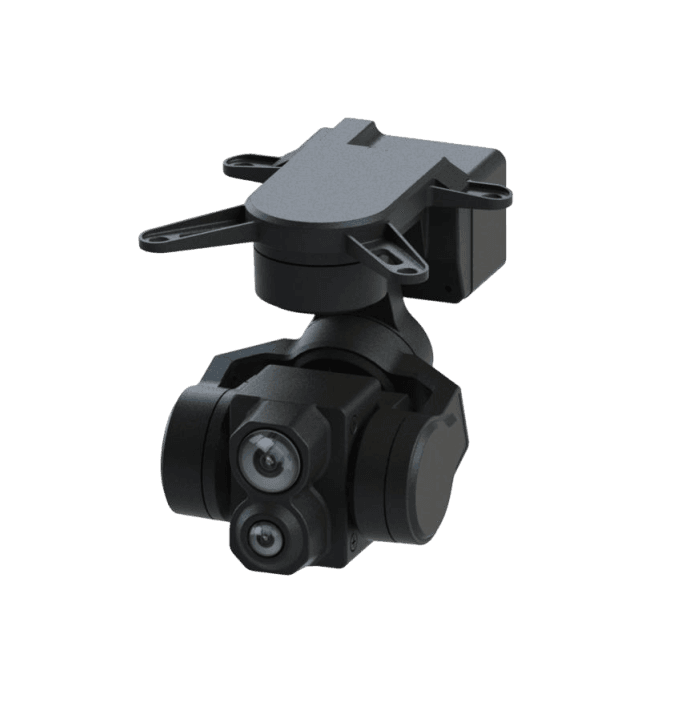
DC1 Micro UAV Gimbal Camera Specifications
The DC1 uses a compact dark gray gimbal body with two vertically arranged optical apertures. Notably, the upper aperture is identified as the FHD EO camera. Four mounting arms with elongated openings surround the upper platform. Consequently, the mechanical design is intended for compact UAV payload and mobile-platform integration.
| Parameter | DC1 specification |
|---|---|
| Model and type | DC1 micro gimbal |
| Weight | 71 g |
| Imaging system | Dual visible-light imaging system with FHD EO camera |
| Video resolution | 1920 × 1080 at 50 fps |
| Zoom | 10× optical zoom; 40× hybrid zoom |
| Field of view | 98.5° × 66.3° wide; 26.2° × 14.9° telephoto |
| Stability accuracy | 0.1 mrad at 1°/2 Hz, 1σ |
| Axis ranges | Yaw ±150°; pitch -90° to +30°; roll ±45° |
| Maximum angular velocity | At least 100°/s |
| Video output and encoding | UDP/RTSP; H.264/H.265; MP4 storage |
| Control | RS232 and network control |
| Power input | 12–28 V DC |
| Power consumption | Average ≤15 W; maximum ≤30 W |
| Operating and storage temperature | -20°C to +50°C |
Stable Wide-Angle and Telephoto Observation
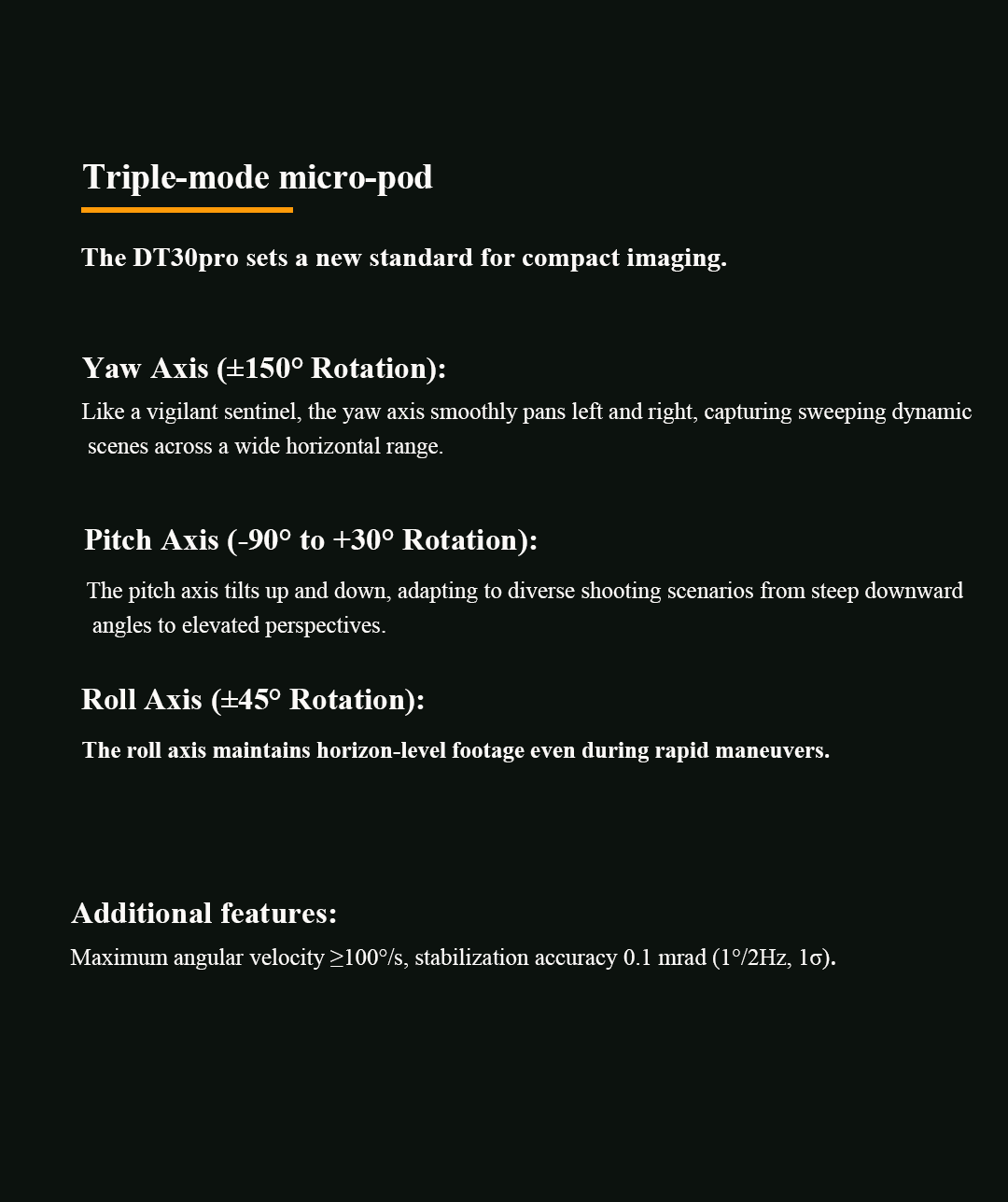
The three-axis structure corrects movement across yaw, roll, and pitch. Specifically, the roll axis helps maintain a level horizon during fast maneuvers. The yaw axis provides broad left-to-right coverage. Meanwhile, the pitch range supports steep downward viewing and elevated observation angles. Therefore, the DC1 micro UAV gimbal camera can maintain more usable imagery when its host platform vibrates, turns, or changes direction.
Zoom flexibility also improves mission efficiency. Firstly, the 98.5° × 66.3° wide field of view supports broad-area searches. Secondly, 10× optical zoom lets the operator inspect a selected target without immediately repositioning the aircraft. Finally, 40× hybrid zoom extends the available viewing range when additional magnification is required. As a result, one FHD EO camera can support both scene awareness and focused observation.
Video, OSD, and Platform Integration
The DC1 UAV payload camera supports UDP/RTSP output for network-based viewing. In addition, it uses H.264 or H.265 encoding and stores video in MP4 format. These established formats can simplify live monitoring and recorded-video management. Furthermore, RS232 and network control give integrators two ways to connect the gimbal with an aircraft, robot, or ground-control system.
Picture-in-picture viewing helps operators retain context while examining a magnified region. Moreover, the rich OSD can show camera, target, and robot or platform information. Example overlays include the date, time, frame rate, zoom level, field-of-view angle, and recording status. They can also include coordinates, tracking mode, heading scales, angle scales, and a central targeting reticle. Consequently, operators can review important mission information without leaving the live video interface.
- Network video: UDP/RTSP streaming with H.264 or H.265 encoding.
- Recorded media: MP4 storage for standard playback workflows.
- Platform control: RS232 serial control or network control.
- Operator display: Picture-in-picture and configurable OSD information.
- Electrical integration: 12–28 V DC input with average consumption up to 15 W.
Mechanical Dimensions and Mounting Considerations
The technical drawing lists a front-view width of 41.2 and a height of 56.2. Additionally, the side-view depth is marked as 52.1, while the upper vertical dimension is 43.2. The dual-lens rotation area is labeled Ø41.1, and the lens-axis offset is 5.9. However, the drawing does not explicitly identify the measurement unit. Therefore, integrators should confirm units before producing a mounting plate or enclosure.
The mounting footprint shows a maximum width of 46.4 and an inner width of 41. Moreover, vertical markings include 27.6, 23.2, and 24.5. Mechanical-interface details are also marked 8.5 and 3.4. Because these values affect fit and clearance, teams should verify the current mechanical drawing before final installation.
Practical Uses for the DC1 UAV Payload Camera
The low payload weight makes the DC1 suitable for small UAV imaging and aerial observation. For instance, public-security teams can use stabilized visible-light video for scene monitoring. Similarly, law-enforcement and border-observation teams can move between broad surveillance and detailed telephoto views. The FHD EO camera can also support mobile security platforms that require responsive pan, tilt, and roll stabilization.
Industrial inspection is another practical application. Specifically, the stabilized video can help operators examine facilities, structures, and difficult work areas from a safer position. Meanwhile, environmental teams can use the drone gimbal camera for mobile monitoring and documentation. Forest-fire projects may also use visible-light observation to review terrain and changing scene conditions. However, this model should not be treated as a thermal camera unless a separate thermal configuration is confirmed.
- Small-UAV payload imaging and wide-area aerial observation
- Robotic vision and mobile stabilized imaging
- Industrial facility and structural inspection
- Public-security and security-surveillance monitoring
- Environmental and forest-fire observation projects
- Law-enforcement and border-area observation
- Dynamic monitoring from vibrating or rapidly moving platforms
Important Configuration Notes
The verified product information identifies the DC1 as a dual visible-light imaging system. However, some promotional graphics contain inconsistent references to a “triple sensor,” “C1,” or “DT30pro.” One graphic also uses a thermal-style picture-in-picture example. Nevertheless, the available DC1 specification table does not provide confirmed thermal-sensor or laser-rangefinder parameters. Therefore, buyers should verify those optional capabilities before ordering if a mission requires thermal imaging, laser ranging, or day-and-night multispectral operation.
For confirmed configurations, the DC1 micro UAV gimbal camera delivers a strong combination of low weight and stabilized FHD video. Moreover, its zoom range, OSD tools, and standard control interfaces support adaptable platform integration. Consequently, it is a practical choice for teams seeking a compact drone gimbal camera for visible-light observation.
Related links
website
product-link
https://uavauto.com/product/dc1-3-axis-dual-visible-fhd-eo-optical-zoom-micro-uav-gimbal-camera/
Phone
Related Posts
-
DA0T1 High-Speed Seeker: 120 fps Electro-Optical Seeker with AI Target Tracking
-
DA531 EO/IR Gimbal: Lightweight Three-Axis UAV Gimbal Camera with Thermal Imaging
-

UAV Camera Selection Guide – How to Choose Camera Modules for Drone Payloads
-
Aurora Mini DSQ09 Thermal Core Module: Compact 640×512 OEM Imaging