
DA60B Micro Gimbal: 140g EO/IR Thermal Camera for Drones
Precision EO/IR Imaging for Weight-Critical UAV Missions
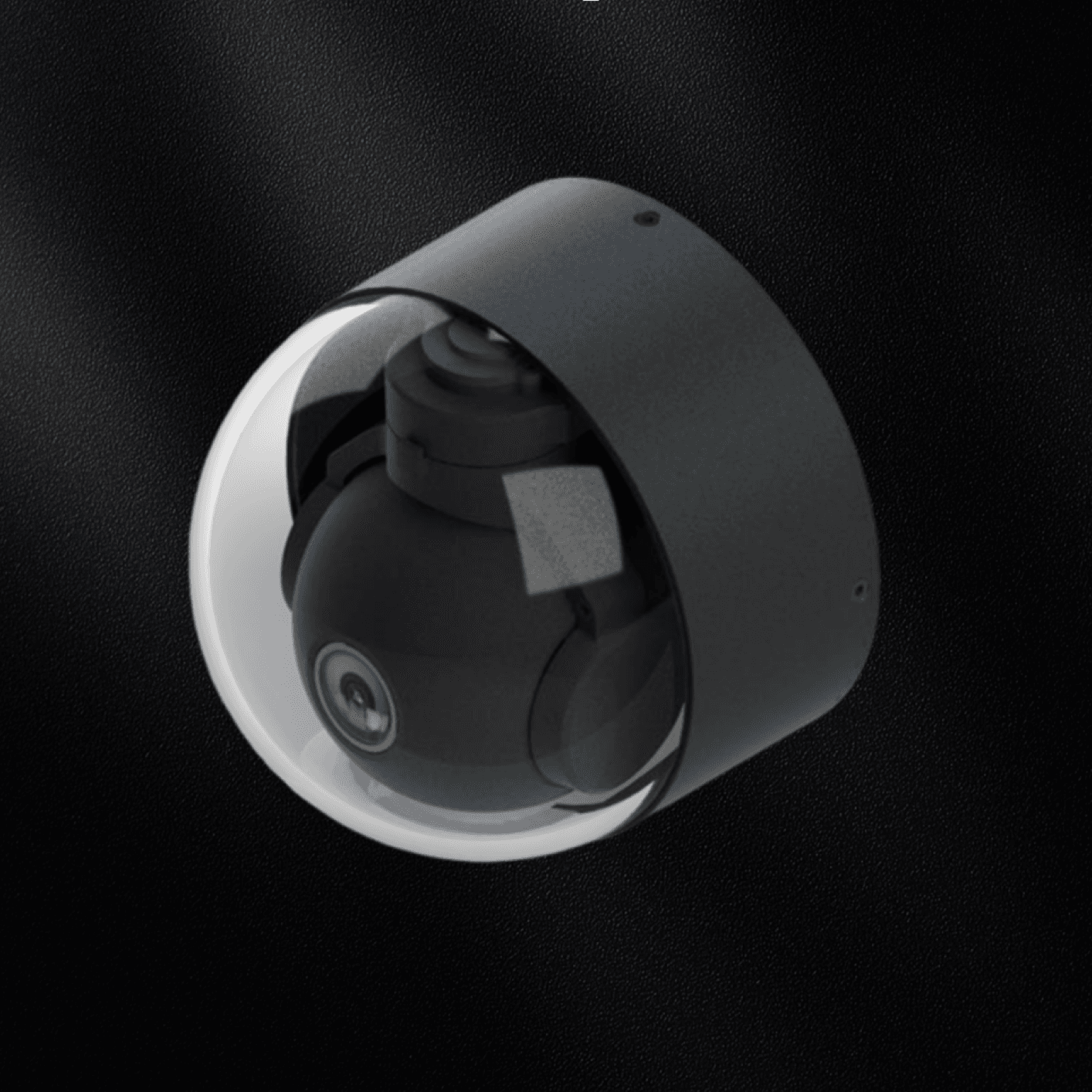
The DA60B Micro Gimbal brings visible-light imaging, thermal detection, stabilization, and dynamic tracking together in a compact 140g payload. Specifically, this thermal imaging camera is engineered for small drones, unmanned ground vehicles, and robotic platforms where payload weight directly affects endurance. Its two-axis, gyro-stabilized design actively adjusts the imaging assembly to reduce vibration and unwanted movement. Meanwhile, operators can capture visible details and thermal signatures at the same time. Intelligent image fusion can also combine object shape and color with heat-source information, improving situational awareness in darkness, smoke, fog, and changing light. Moreover, the integrated target tracking gimbal function can lock onto moving subjects and follow their trajectories in real time. The system supports 1920 × 1080 visible imaging at 60 fps, three visible-light lens options, and network video output. In addition, its 12–28V DC input and average power consumption of no more than 6W simplify integration with varied platforms. As a result, the DA60B offers a practical balance of low weight, imaging performance, and mission flexibility.
DA60B Micro Gimbal Specifications at a Glance
Firstly, the DA60B is built around a two-axis gyro-stabilized platform with broad pitch and yaw movement. Its yaw range extends from -110° to +110°, while its pitch range runs from -100° to +40°. Furthermore, the assembly can move at a maximum angular velocity of at least 100° per second. Stability accuracy is rated at 0.1 mrad, and motor encoder accuracy is no more than 0.3°. Therefore, the payload can react quickly while maintaining controlled pointing performance.
| Parameter | DA60B specification |
|---|---|
| Weight | 140g |
| Visible imaging | 1920 × 1080 at 60 fps |
| Visible-light lenses | 12mm, 16mm, or 25mm |
| Fields of view | 27° × 15°, 19° × 11°, or 12° × 7° |
| Movement ranges | Yaw: -110° to +110°; pitch: -100° to +40° |
| Tracking speed | At least 40°/s |
| Control interfaces | TTL, RS232, and SBUS |
| Power input | 12–28V DC |
| Power consumption | Average ≤6W; maximum ≤15W |
| Operating temperature | -20°C to +55°C |
| Impact resistance | At least 400g launch impact |
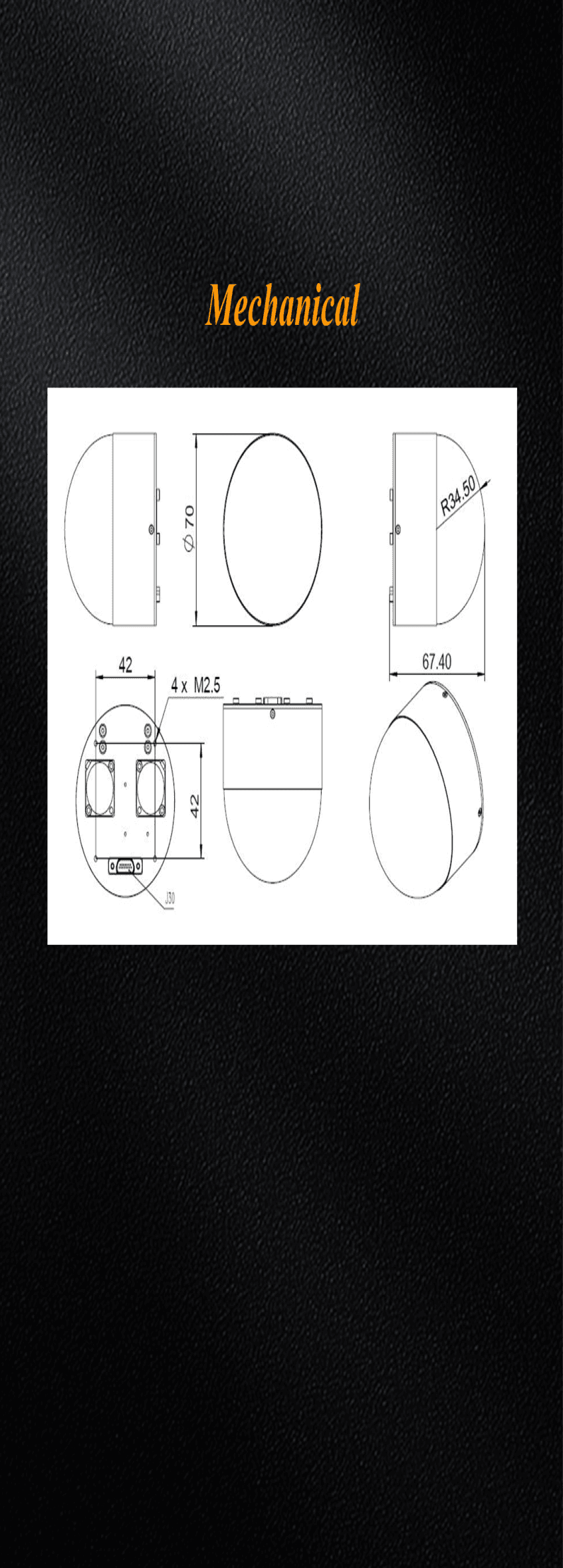
| Approximate dimensions | Ø70 × 67.40mm |
| Mounting pattern | 42 × 42mm with four M2.5 holes |
Dual-Light Thermal Imaging Camera Performance
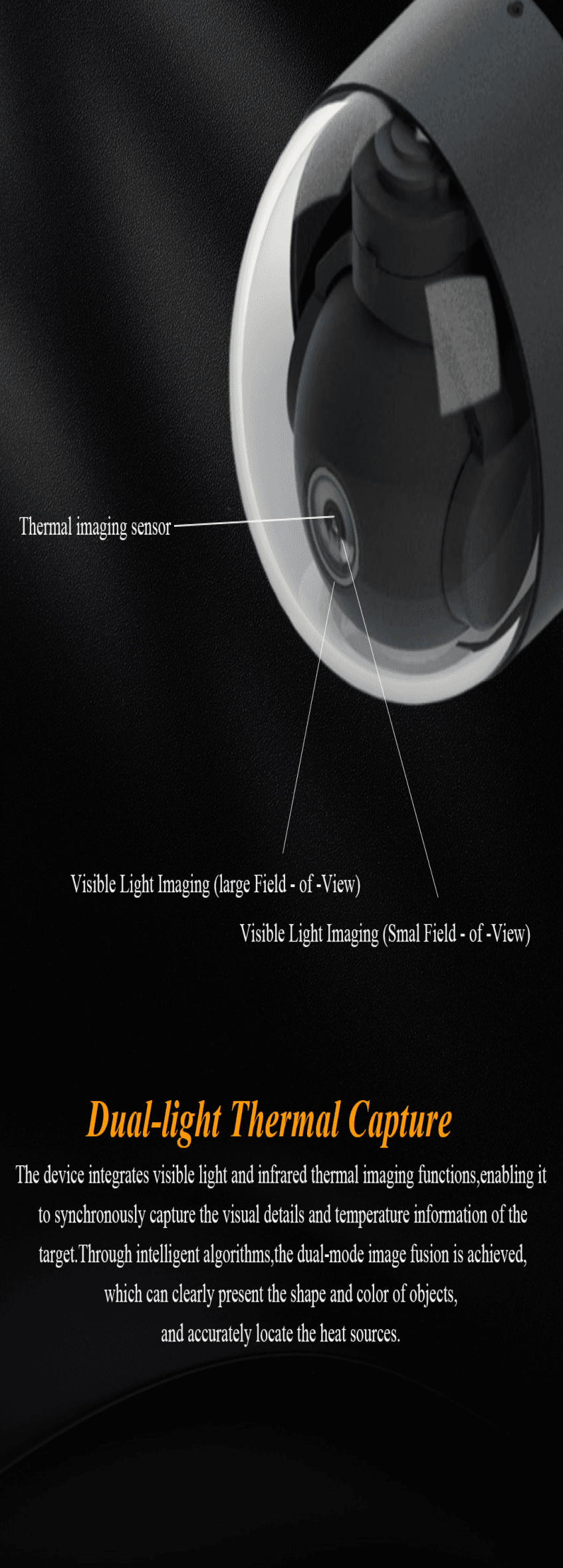
The optical assembly places several imaging apertures behind a clear hemispherical protective dome. Visually, the compact pod has a rounded gray housing with a black internal camera assembly. More importantly, it combines a thermal sensor with large-field-of-view and small-field-of-view visible channels. Consequently, operators can observe recognizable visual details while locating heat sources within the same mission workflow.
The visible channel records Full HD video at 60 fps. Moreover, users can select a 12mm, 16mm, or 25mm lens for different observation requirements. The 12mm option provides a 27° × 15° field of view. In contrast, the 25mm lens narrows that view to 12° × 7° for more focused observation. The intermediate 16mm option provides a 19° × 11° field of view. Therefore, integrators can balance scene coverage and target detail according to the platform’s intended mission.
How the Target Tracking Gimbal Maintains a Stable View
The dual-axis servo system senses platform movement and dynamically adjusts the camera’s pitch and roll orientation. Accordingly, it helps reduce jitter, vibration, and pointing deviation during flight or vehicle movement. This stabilization is especially valuable on micro-UAVs, where compact airframes can transmit noticeable vibration to the payload.
Meanwhile, the built-in target tracking gimbal module supports target acquisition and continuous following. Its rated tracking speed is at least 40° per second. Therefore, it can respond to vehicles, pedestrians, and other moving subjects in dynamic scenes. In addition, tracking is promoted for crowded areas and environments with changing illumination. These capabilities support surveillance and reconnaissance workflows without requiring constant manual pointing.
Practical UAV and Robotics Applications
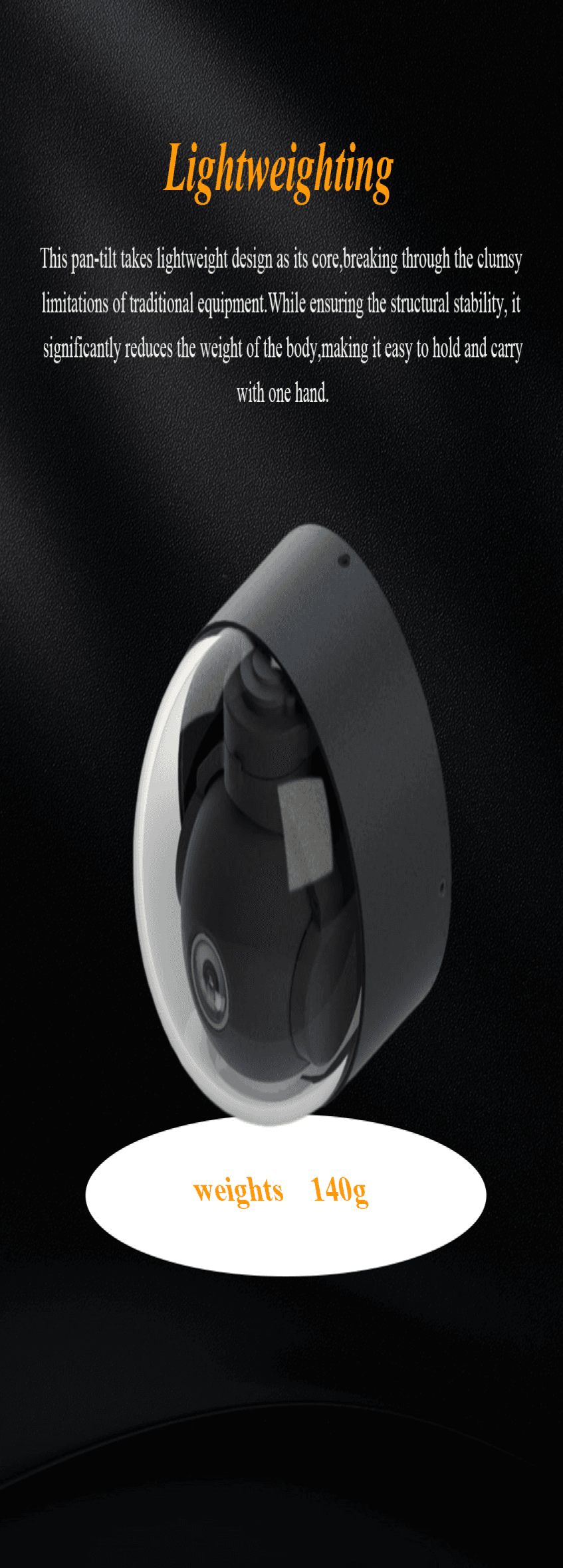
Because it weighs only 140g, the DA60B Micro Gimbal suits platforms where payload capacity is limited. For instance, small UAVs can use it for aerial patrol, environmental observation, mapping support, and infrastructure inspection. Similarly, its compact dimensions make it suitable for unmanned ground vehicles and marine robotic systems.
- Search and rescue: The thermal imaging camera can help teams locate human heat signatures in darkness, smoke, or dense fog.
- Industrial inspection: Operators can examine power equipment, pipelines, wind turbines, and solar installations from safer positions.
- Security monitoring: The target tracking gimbal can follow moving vehicles or pedestrians across urban and perimeter environments.
- Emergency response: Dual-mode imaging can support wildfire observation, disaster assessment, and hazardous-scene monitoring.
- Robotic reconnaissance: The rugged design can withstand a launch impact of at least 400g.
Furthermore, the operating range of -20°C to +55°C supports deployment across varied climates. The unit can also be stored between -20°C and +60°C. Nevertheless, integrators should confirm environmental, mounting, control, and video compatibility for their complete platform before deployment.
Flexible Control and Power Integration
The DA60B supports TTL, RS232, and SBUS control interfaces, while video is delivered through a network connection. Consequently, system developers have several options for connecting flight controllers, ground stations, or autonomous navigation equipment. The wide 12–28V DC input also accommodates different onboard electrical architectures.
Notably, average consumption is limited to 6W or less, while maximum consumption is 15W or less. Therefore, the payload reduces continuous power demand compared with heavier, higher-consumption systems. The design is also advertised as following EMC specifications, although no specific EMC standard number is listed in the supplied information.
A Compact EO/IR Payload Built for Demanding Missions
In conclusion, the DA60B Micro Gimbal combines a 140g structure with stabilized EO/IR imaging, selectable visible-light optics, and real-time tracking. Moreover, its efficient power profile helps preserve mission endurance on weight-critical aircraft. The thermal imaging camera supports observation when visible-only systems become limited. Meanwhile, the target tracking gimbal adds practical support for moving-subject surveillance. Together, these features make the DA60B a versatile payload for UAV, security, inspection, rescue, and robotic applications.
Related Links
Website
Product Link
https://uavauto.com/product/da60b-140g-ultra-lightweight-dual-axis-eo-ir-micro-gimbal/
Phone
Related Posts
-
DA0T1 High-Speed Seeker: 120 fps Electro-Optical Seeker with AI Target Tracking
-
DA60N Mini Infrared UAV Pod: 200g Thermal Camera Payload for Catapult Drones
-
DA531 EO/IR Gimbal: Lightweight Three-Axis UAV Gimbal Camera with Thermal Imaging
-
DT30DL Multi-Sensor Dual-Field EO/IR Laser Rangefinder Gimbal for Drone Surveillance