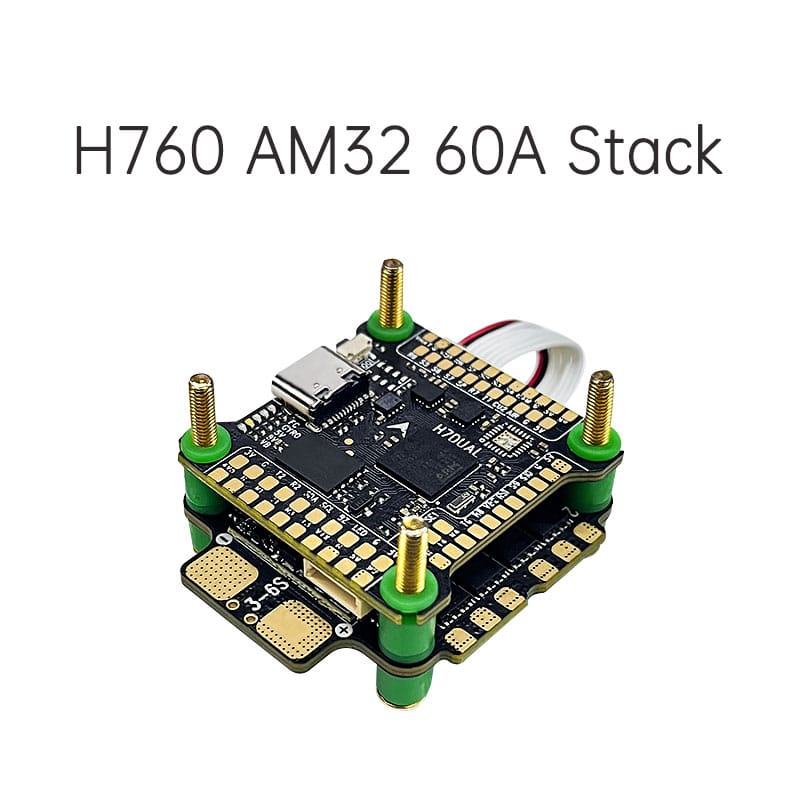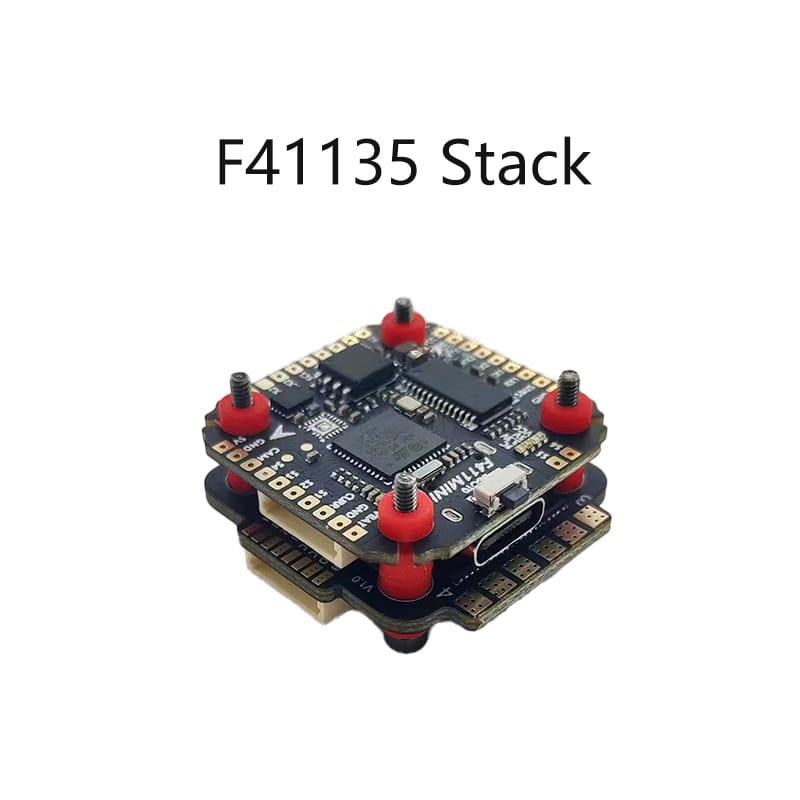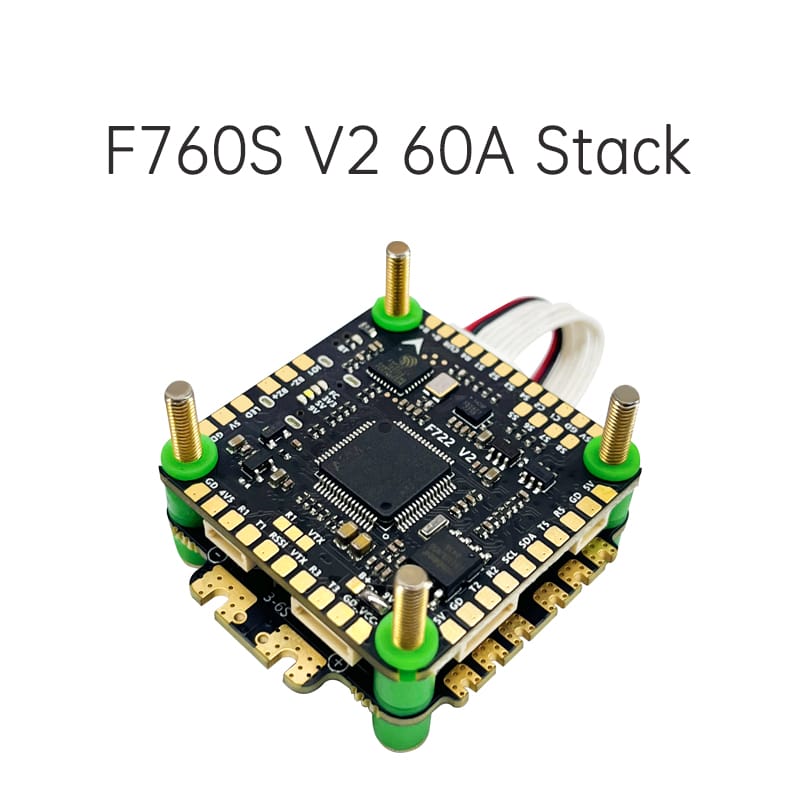
D-F460S V3 FPV Stack: F405 Control and 60A Power
A Compact Control Stack for Demanding FPV Builds
The D-F460S V3 combines an F405 flight controller with a 60A 4-in-1 ESC in a compact stack for FPV multirotors. At its core, the F405 V3 board uses an STM32F405RGT6 processor, an ICM42688P gyroscope and an SPL06 barometer. Meanwhile, the 3060S ESC supports 3S to 6S LiPo power and delivers up to 60A continuously across each of its four channels. The stack also supports OSD, Bluetooth, multiple receiver protocols and direct DJI/Vista connections. In addition, five serial-port groups simplify connections for GPS, receivers, ESC telemetry, video transmitters and Bluetooth. Its 30.5 x 30.5 mm mounting pattern suits many freestyle and performance-oriented airframes. Therefore, builders can consolidate flight control, motor management and peripheral connections into one coordinated package. The included filtering capacitor and shock-absorbing mounting hardware also help create a cleaner installation. However, builders should verify jumper settings and output voltage before connecting sensitive FPV equipment.
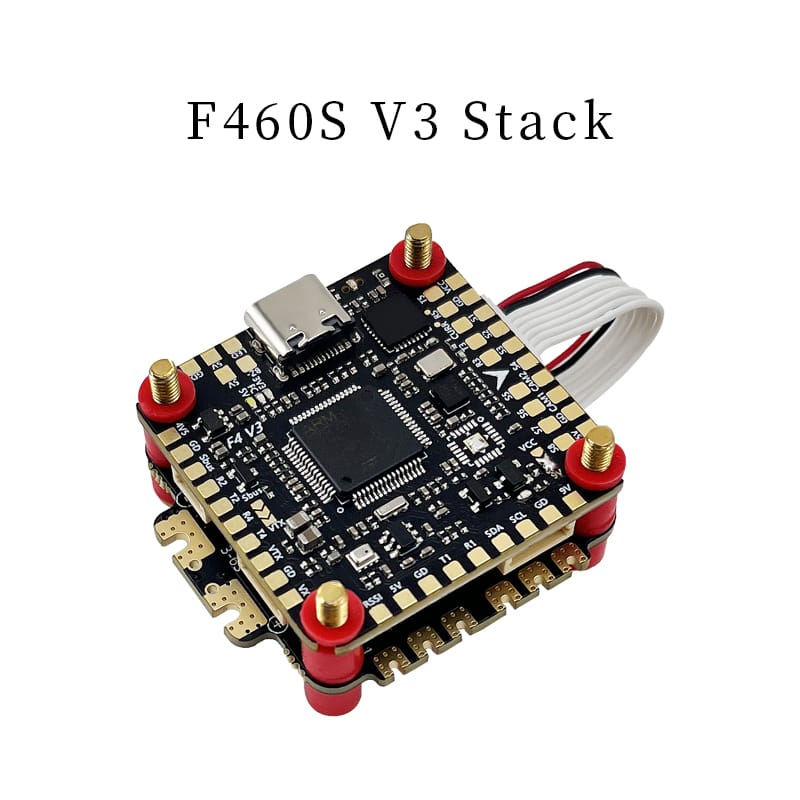
Visually, the stack uses two square black circuit boards with exposed gold solder pads. The flight controller places its STM32 processor near the center and its silver USB Type-C port along one edge. Below it, the ESC carries multiple MOSFETs and large pads for battery and motor wiring. Moreover, red vibration-damping mounts, brass-colored standoffs and black screws secure the assembled boards. A white eight-pin cable links both layers, which reduces separate signal wiring inside the aircraft.
Core Specifications at a Glance
The two-board design pairs the F405 V3 FC with the 3060S 60A 4-in-1 ESC. Specifically, the flight controller measures 36 x 36 mm and weighs 8.2 g. The ESC specification tables list a 40 x 40.7 mm footprint and a weight of 10.4 g. Both boards use 30.5 x 30.5 mm mounting positions. Consequently, the stack fits the established 30 x 30 class while retaining room for accessible solder pads.
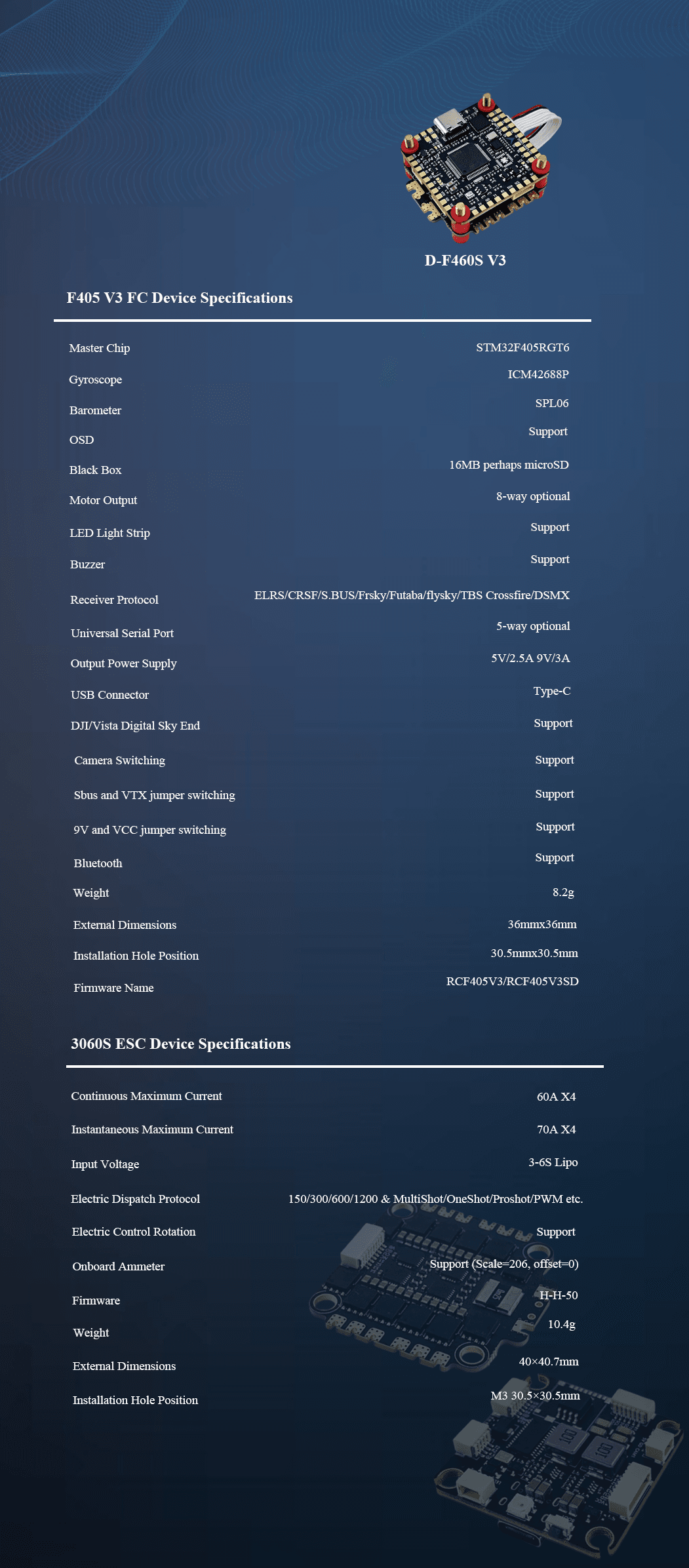
Specification note: The product graphics contain several conflicting secondary measurements. For example, one ESC size diagram marks 40 x 37 mm, while the specification tables state 40 x 40.7 mm. The same diagram annotates 0.5 mm beside the FC profile and 0.7 mm beside the ESC profile. Therefore, builders with extremely tight frames should confirm physical clearance before assembly.
F405 Flight Controller Connections and Functions
The F405 flight controller provides five configurable serial-port groups. In the supplied wiring chart, UART1 serves GPS, UART2 serves the receiver and UART3 connects with the ESC. Meanwhile, UART4 handles the VTX connection, while UART5 is assigned to Bluetooth. This organized layout helps builders separate essential peripherals without crowding a single connection point.
Receiver support includes ELRS, CRSF, S.BUS, FrSky, Futaba, Flysky, TBS Crossfire and DSMX. In addition, the board supports PPM and iBUS-style installations shown in the connection graphics. Up to eight motor outputs are listed, making the controller suitable for more than standard quad-motor layouts. Moreover, the board supports an external buzzer, addressable LED strips and an onboard WS2812 LED.
Onboard OSD, SPL06 barometer and black-box recording support.
Analog VTX, DJI/Vista hardware and dual-camera switching.
USB Type-C connector and Bluetooth support through UART5.
Specification tables list 5V/2.5A and 9V/3A regulated outputs.
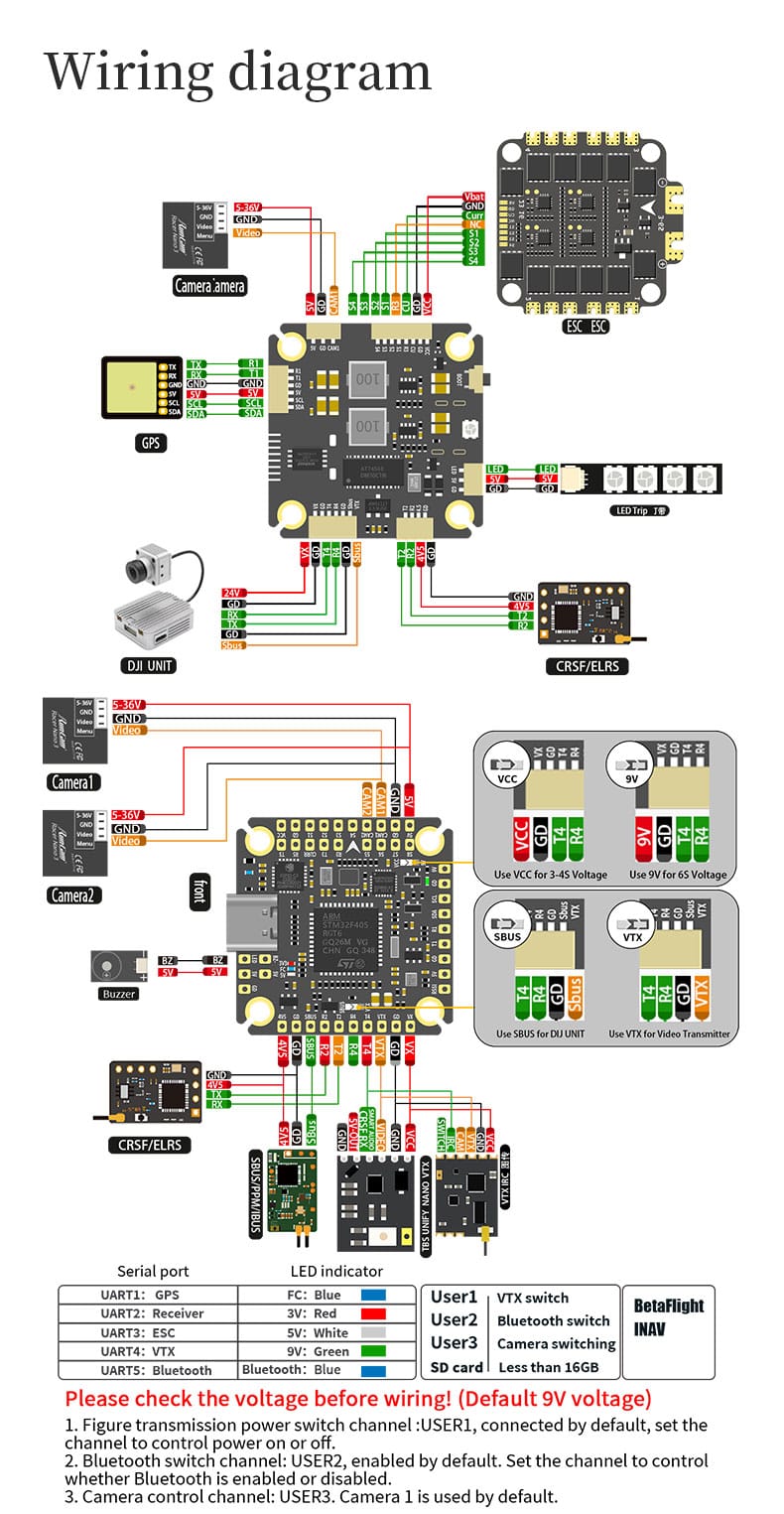
The wiring diagram also identifies three user functions. USER1 controls image-transmission power, USER2 controls Bluetooth and USER3 switches the camera input. Notably, Camera 1 is selected by default. Bluetooth is also enabled by default, while the image-transmission power connection can be switched through USER1. Furthermore, the status indicators identify FC blue, 3V red, 5V white, 9V green and Bluetooth blue LEDs.
Two-camera wiring allows pilots to switch between analog camera inputs through software control. Similarly, the direct-insertion interface supports DJI/Vista digital video hardware. A separate jumper selects between SBUS and VTX functions. Therefore, users should review the pad map before soldering either configuration.
60A 4-in-1 ESC Power and Protocol Support
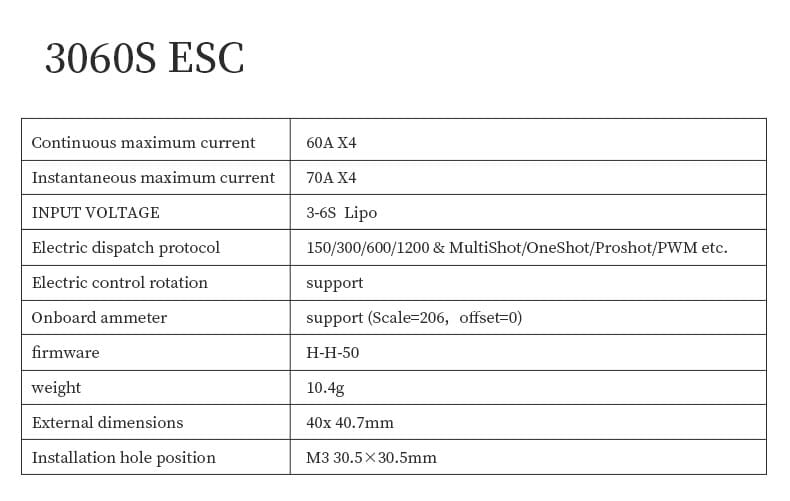
The 3060S 60A 4-in-1 ESC supplies 60A continuously per motor channel. It also supports a stated 70A instantaneous maximum per channel. As a result, the ESC is designed for performance-focused 3S through 6S FPV aircraft. Large edge pads provide accessible soldering points for battery and motor leads, while the distributed MOSFET layout handles the four motor channels on one board.
The supported signal options are listed as 150, 300, 600 and 1200 rates. Additionally, the documentation names MultiShot, OneShot, ProShot and PWM support. H-H-50 firmware enables electronic motor-direction control, so builders can adjust supported rotation settings without physically swapping motor wires. Moreover, the onboard ammeter supports current monitoring with scale 206 and offset 0.
Power setup reminder: The wiring chart states that VCC should be used for 3S to 4S voltage, while 9V should be used for 6S voltage. However, the diagram also warns that the jumper defaults to 9V. Consequently, always measure the selected output before connecting a camera, VTX or digital air unit.
A 1000 uF, 35V capacitor is included for power filtering. Specifically, the capacitor can help reduce electrical noise within the power system when installed correctly. The 60A 4-in-1 ESC also shares the stack’s M3 30.5 x 30.5 mm mounting layout, which keeps installation straightforward in compatible frames.
Storage and BEC Details to Verify
The product graphics describe black-box storage in different ways. One specification table lists “16MB perhaps microSD,” while another graphic promotes an SD card slot and 4GB black-box flash memory. Meanwhile, the wiring chart instructs users to install an SD card smaller than 16GB. Therefore, buyers who require a specific logging configuration should verify the supplied FC variant and firmware target before ordering.
The regulated output ratings also vary between graphics. The detailed specification tables list 5V/2.5A and 9V/3A outputs. In contrast, one feature graphic states 5V/2A and 9V/2A dual BEC outputs. Accordingly, conservative power planning is recommended until the ratings on the delivered board are confirmed.
FPV Build Applications
The D-F460S V3 is designed for multirotor and FPV drone builds that need integrated motor control. For instance, it can connect to an analog camera, GPS module, addressable LED strip, buzzer and CRSF or ELRS receiver. Alternatively, builders can configure it for a DJI digital camera and Air Unit installation. The dual-camera input also supports aircraft that need selectable viewing angles or specialized secondary cameras.
Because the 60A 4-in-1 ESC accepts 3S through 6S LiPo input, it supports several common FPV power configurations. Furthermore, the ICM42688P gyroscope, onboard barometer and OSD provide the core sensing and display functions needed for a complete build. Betaflight and INAV labels appear in the supplied wiring references. However, users should confirm firmware compatibility with the RCF405V3 or RCF405V3SD target before flashing the board.
Included Components
The package includes the main boards, installation hardware and essential power accessories. Specifically, the listed contents are:
- 1 x F405 V3 flight controller
- 1 x 3060S 60A 4-in-1 ESC
- 1 x eight-pin SH1.0 connection cable
- 1 x XT60 power lead
- 8 x M3 red shock-absorbing balls
- 8 x nuts
- 4 x M3 x 25 mm metal screws
- 1 x 1000 uF, 35V capacitor
Key takeaway: The D-F460S V3 brings together an STM32F405-based controller, broad peripheral support and a 60A four-channel ESC. Therefore, it offers a coordinated foundation for compact 3S to 6S FPV builds. Careful jumper selection and voltage testing remain essential during installation.
Contact Us for Orders & Inquiries
Website
Product Link