DS063pro: High-Speed AI Video Tracking Board for UAV and Gimbal Payloads
AI Intelligent Module · Product guide
The DS063pro is an embedded AI video processing board for real-time detection, recognition, locking and tracking of targets such as people, vehicles, boats, aircraft and drones. It pairs a domestic AI chip with proprietary image algorithms, accepts high-frame-rate global shutter camera feeds, and reports target type, position, size and miss-distance relative to image center, suited to UAV payloads, EO/IR gimbals and custom vision development.
Verified specifications
| Product model | DS063pro |
|---|---|
| Tracking frame rate | 120Hz |
| Tracking accuracy | ≤1 pixel, with tracking speed ≥64 pixels/frame |
| Recognition performance | 25Hz recognition, 10×10 pixel minimum target, 0.616 mAP@0.5 on VisDrone2019-DET-test-dev |
| Maximum tracked targets | Up to 64 |
| Video input | 3-channel MIPI custom adaptation; 1-channel DVP custom adaptation; visible-light and infrared single or dual channel with command-based switching |
| Video output | 1-channel CVBS |
| Host interfaces | 2-channel UART (TTL 3.3V), 1-channel USB 2.0, 1-channel 100M Ethernet with default RTSP stream output |
| Power | 9–36V operating voltage, under 6W consumption |
| Size and weight | 55mm × 40mm including connectors; 24.6 ± 2g bare board without heatsink |
| Operating temperature | -20℃ to +60℃ |
Imaging Inputs and Sensor Adaptation
Video input is handled through 3-channel MIPI or 1-channel DVP, both listed as custom adaptations, so an integrator should confirm sensor and board revisions before wiring. The referenced compatible camera is a global shutter monochrome unit at 1080P with 120Hz or 60Hz frame rate and auto exposure support.
Infrared runs as a single-channel or dual-channel path with command-based channel switching, which lets one payload move between day and night sensing. A 640×512 thermal imaging module at 50Hz is referenced, adapted over MIPI, DVP or USB UVC depending on the module selected.
Tracking and Recognition Performance
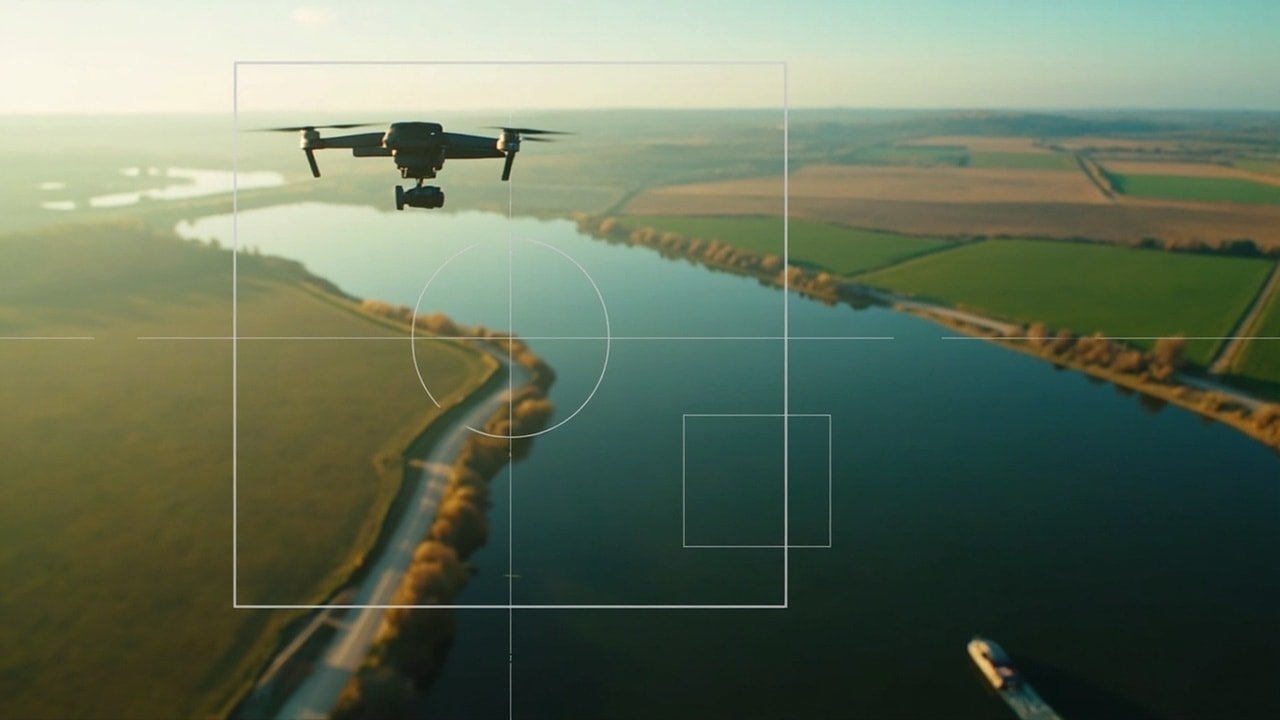
Tracking runs at 120Hz with a stated accuracy of ≤1 pixel and a tracking speed of ≥64 pixels per frame — the figures that matter for small, fast-moving targets. The minimum tracked target is 2×2 pixels for centroid tracking and 8×8 pixels for correlation tracking, with a minimum centroid target contrast of 5%.
Recognition is a separate 25Hz stage requiring a 10×10 pixel target, with reported performance of 0.616 mAP@0.5 on the VisDrone2019-DET-test-dev open-source dataset. Available algorithms include centroid, form-center, correlation filter, multi-target and intelligent tracking, and up to 64 targets can be tracked simultaneously.
Target Locking and OSD Workflow
Locking can be commanded by point selection, box selection, image-center locking, crosshair-center locking, target ID locking and automatic search-and-lock-on. Because the board reports miss-distance relative to image center, a gimbal controller can steer against that reported offset rather than relying on frame differencing alone.
The OSD overlay can show time, date, version information, target box, crosshair, scale, compass, latitude and longitude, plus yaw and pitch angles, which helps operators check alignment during commissioning. Electronic zoom reaches 16x with 0.1 minimum zoom precision, and onboard photo and video recording is reachable over FTP.
Host Integration and Network Streaming
Host communication runs over 2-channel UART at TTL 3.3V, with USB 2.0 also provided. Video leaves the board as 1-channel CVBS, while the 100M Ethernet port carries a default RTSP stream, giving integrators a choice between a direct analog path, a serial command link and networked streaming.
Management is network-based: firmware upgrade, model file upgrade, running log query, interface configuration and factory reset are all supported. RTSP output also lets ground stations or a recording system observe the same feed while the payload continues tracking.
- Confirm the MIPI or DVP sensor adaptation matches your chosen camera or thermal module
- Verify a 9–36V supply and confirm the payload stays within the under 6W budget
- Plan UART command parsing for target type, position, size and miss-distance
- Decide whether CVBS output, RTSP streaming or both are required downstream
Lens, Range and Payload Tradeoffs
Lens choice sets the usable range. A 3.6mm low-distortion lens gives a 90°×80°×55° field of view with a 300–500m operating distance for a 1m target, while an 8mm option narrows to 45°×40°×23° at 600–1000m. Both use the standard M12 interface and can be replaced per project requirement.
The board measures 55mm × 40mm including connectors and weighs 24.6 ± 2g without a heatsink, so thermal headroom depends on the enclosure and operating environment; the rated range is -20℃ to +60℃. Under 6W consumption from a 9–36V input keeps the power budget simple for UAV payloads.
Frequently asked questions
What frame rate and accuracy does the DS063pro reach?
Tracking runs at 120Hz with a stated accuracy of ≤1 pixel and tracking speed of ≥64 pixels per frame. Recognition is a separate 25Hz stage with a 10×10 pixel minimum target and 0.616 mAP@0.5 reported on the VisDrone2019-DET-test-dev open-source dataset.
Which cameras and thermal modules can be connected?
Video input is 3-channel MIPI or 1-channel DVP, both custom adaptations. The listed compatible camera is a global shutter monochrome unit at 1080P running 120Hz or 60Hz, and infrared modules of 640×512 at 50Hz are supported through MIPI, DVP or USB UVC depending on module type.
How does the board pass results to a host controller?
Results go out over 2-channel UART at TTL 3.3V, carrying target type, position, size and miss-distance relative to image center. Video output is 1-channel CVBS, and the 100M Ethernet port provides a default RTSP stream for remote viewing and system integration.
Can custom AI models be trained and deployed?
Yes. The board works with the SpeedDP AI development platform for custom dataset training and one-click model deployment. Model files and firmware can be upgraded over the network, alongside running log query, interface configuration and factory reset.