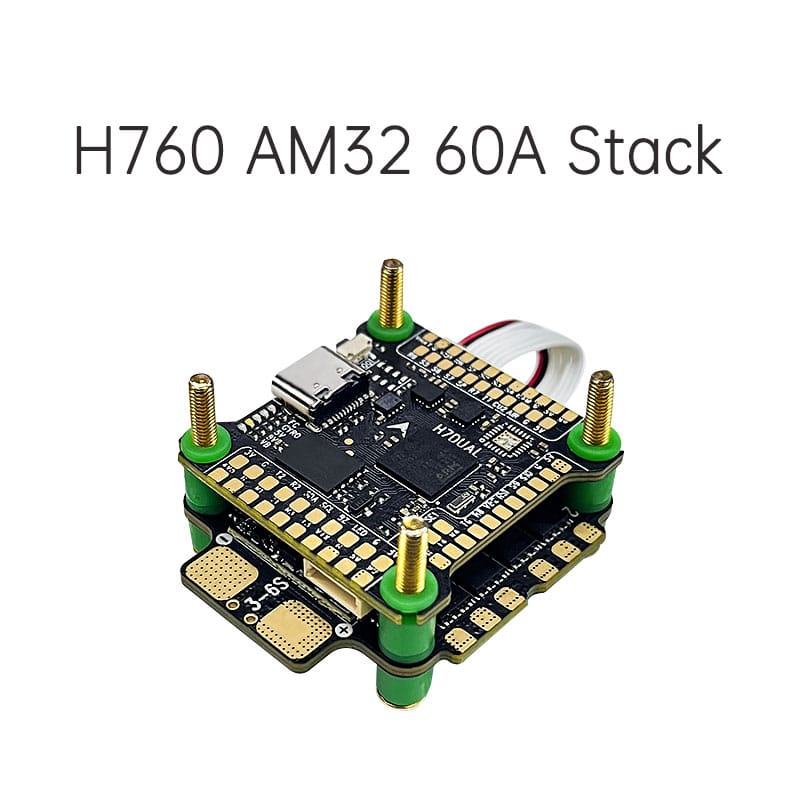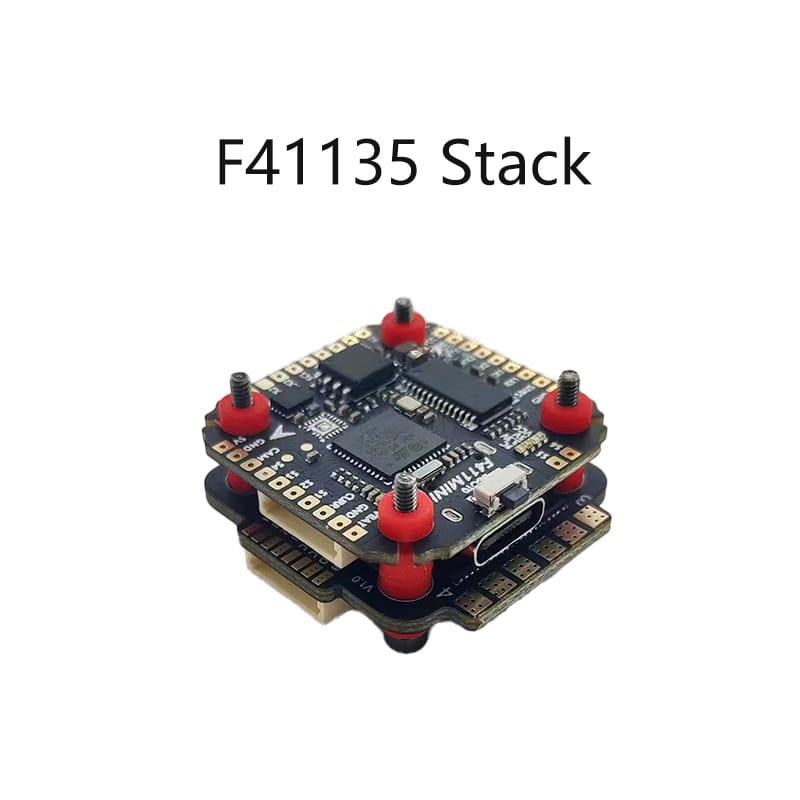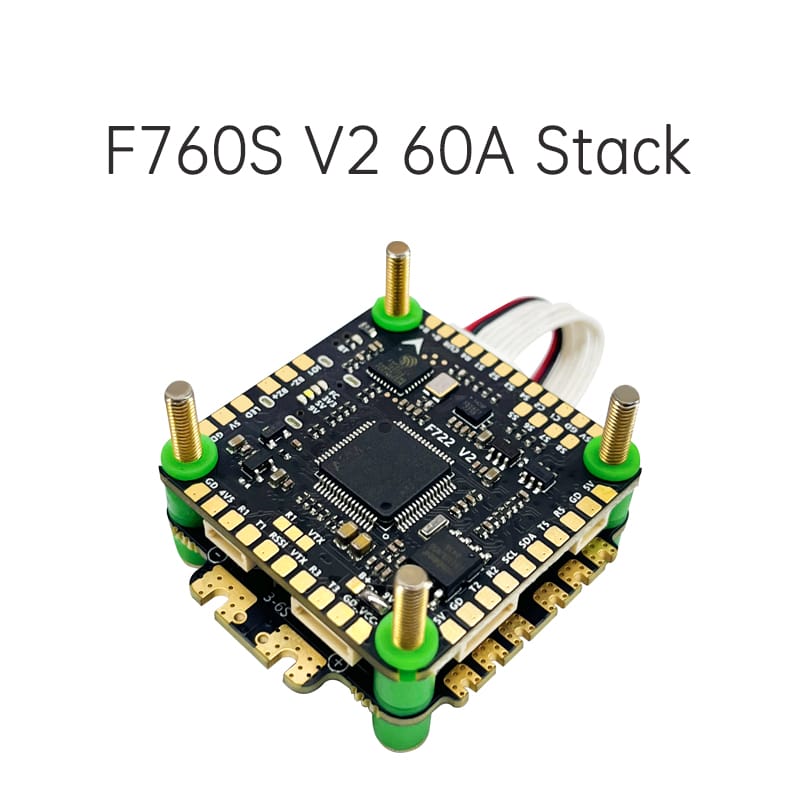
D-F460 V4 AM32 60A Stack for FPV Freestyle Drones
A Compact Power and Control Platform for Demanding FPV Builds
The D-F460 V4 AM32 60A Stack combines an F405 V4 flight controller with a Bettle 3060 60A 4-in-1 ESC. Together, these boards create a compact control and power system for FPV freestyle drones. Specifically, the ESC supports 3–6S LiPo batteries and delivers 60A continuously through each of its four motor channels. It can also handle 70A burst current per channel. Moreover, AM32 firmware, current sensing, telemetry, and bidirectional DShot provide useful tuning and monitoring options. The flight controller supports ELRS, CRSF, S.BUS, FrSky, Futaba, FlySky, TBS Crossfire, and DSMX receivers. In addition, it offers DJI O3 integration, camera switching, and an S.BUS and VTX jumper. Therefore, builders can use the stack with many analog or digital FPV configurations. Its shared 30.5 x 30.5 mm mounting pattern also simplifies installation in compatible freestyle frames. As a result, the stack provides strong output without adding unnecessary wiring or separate motor controllers.
D-F460 V4 Stack Specifications at a Glance
F405 V4, RCF405V4 target
60A x 4 continuous, 70A x 4 burst
3–6S LiPo
30.5 x 30.5 mm
23.3 g
DJI O3 supported
Physical Design and Installation
The assembled unit uses two compact black circuit boards separated by brass standoffs and green vibration-damping components. Notably, exposed gold solder pads line the edges of both boards. These pads provide accessible wiring points for motors, power, receivers, video equipment, and other peripherals. Meanwhile, the centrally mounted flight-controller processor keeps the board layout organized. The USB Type-C port sits along one edge, so firmware access remains convenient after installation. The ESC places motor pads along its left and right edges. Additionally, dedicated BAT- and BAT+ pads sit near the lower edge for the main power connection.
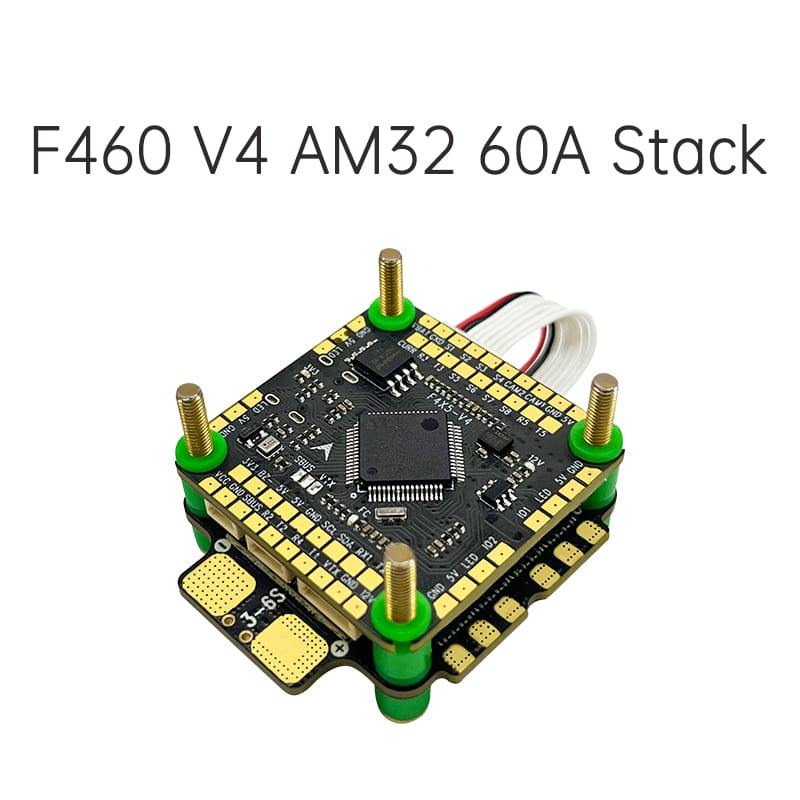
The F405 V4 flight controller measures 36 x 36 mm and weighs 9.4 g. In contrast, the Bettle 3060 ESC measures 41 x 44.5 mm and weighs 13.9 g. Both boards use a 30.5 x 30.5 mm mounting pattern. However, the ESC specifically uses four M3 mounting holes. Consequently, builders should confirm frame clearance around the wider ESC before installation.
Bettle 3060 60A 4-in-1 ESC Performance
The Bettle 3060 ESC controls four brushless motors from one board. Specifically, each channel supports 60A of continuous current and a 70A burst peak. This capacity suits throttle-heavy freestyle maneuvers when the surrounding powertrain is properly matched. Moreover, the ESC accepts DShot300, DShot600, PWM, and bidirectional DShot input signals. Pilots can therefore select a protocol that fits their firmware and tuning requirements.
Telemetry and an onboard current meter are also supported. As a result, compatible flight software can receive useful power-system data. The ESC runs AM32_AT421A firmware and accepts 3–6S LiPo input. Furthermore, its specified operating range is -20°C to +85°C, with 20–95% operating humidity. The listed storage range is -30°C to +70°C. These figures describe component limits, although builders should still provide cooling and avoid moisture exposure.
- Continuous current: 60A x 4
- Burst peak current: 70A x 4
- Input voltage: 3–6S LiPo
- Signals: DShot300, DShot600, PWM, and bidirectional DShot
- Telemetry and current sensing: supported
- Firmware: AM32_AT421A
- Dimensions: 41 x 44.5 mm
- Weight: 13.9 g
F405 V4 Flight Controller Connectivity
The F405 V4 flight controller provides broad receiver compatibility for custom FPV builds. For instance, supported ecosystems include ELRS, CRSF, S.BUS, FrSky, Futaba, FlySky, TBS Crossfire, and DSMX. Consequently, pilots are not restricted to a single radio link. The board also uses the RCF405V4 firmware target and includes a side-facing USB Type-C connector. Therefore, configuration and firmware access are straightforward when the port remains reachable.
Video-system integration is similarly flexible. Specifically, the board supports DJI O3 and includes a camera-switch function. It also provides an S.BUS and VTX jumper. In addition, the documented wiring layout covers analog FPV cameras, video transmitters, receivers, and peripheral modules. Addressable LED-strip connections are shown as well. Thus, the controller can serve as the central wiring point for lighting and FPV equipment.
- Model: F405 V4 flight controller
- Firmware target: RCF405V4
- USB connector: Type-C
- DJI O3 and camera switching: supported
- S.BUS and VTX jumper: included
- Dimensions: 36 x 36 mm
- Mounting pattern: 30.5 x 30.5 mm
- Weight: 9.4 g
Included Components and Build Planning
The package includes the main components needed to assemble the stack. Firstly, it contains one F405 V4 flight controller and one Bettle 3060 ESC. Secondly, an eight-pin SH1.0 interconnection cable links the boards. An XT60 power lead and a 35V 1000µF solid-state electrolytic capacitor are also supplied. Additionally, the mounting set includes eight M3 shock-absorbing balls, eight nuts, and four M3 x 25 mm metal screws.
- F405 V4 flight controller x 1
- Bettle 3060 ESC x 1
- Eight-pin SH1.0 connection cable x 1
- XT60 power lead x 1
- M3 shock-absorbing balls x 8
- Nuts x 8
- M3 x 25 mm metal screws x 4
- 35V 1000µF solid-state electrolytic capacitor x 1
Before soldering, builders should identify the four numbered motor outputs and verify motor order. Next, they should confirm the polarity of the separate BAT- and BAT+ pads. The capacitor and XT60 lead must also be installed with correct polarity. Finally, checking frame clearance and USB access can prevent avoidable rework. These steps support a cleaner and more serviceable FPV freestyle drone installation.