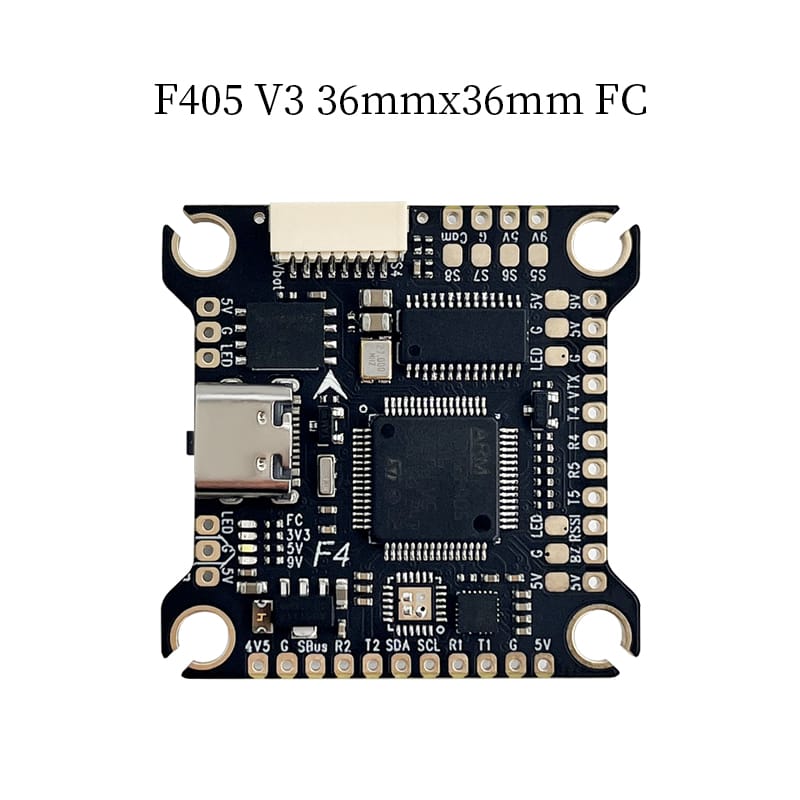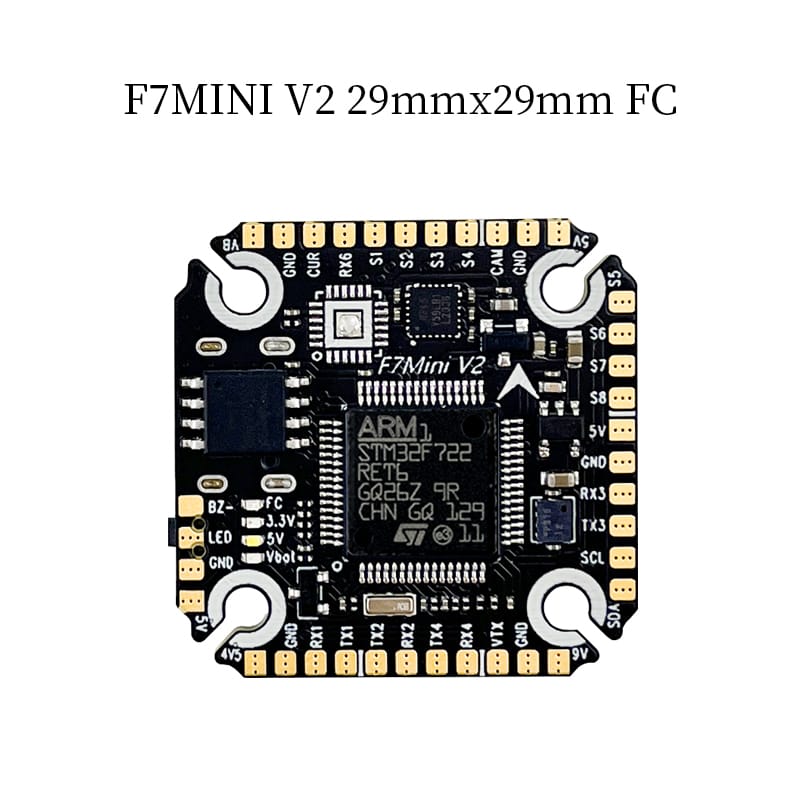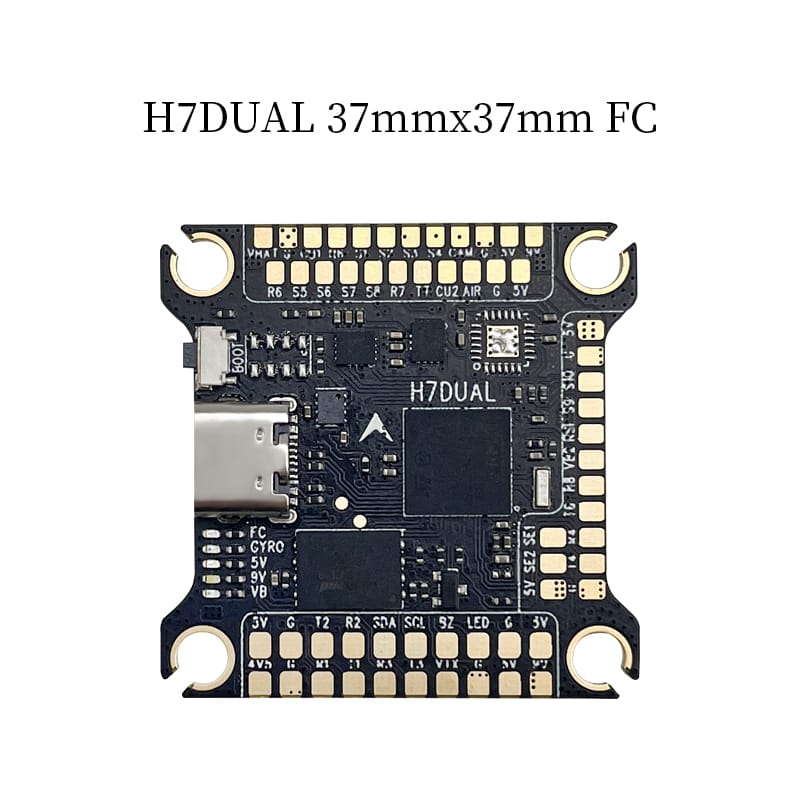
D-F722 V1 Flight Controller: A Compact F7 Board for Racing Drone Builds
A Closer Look at This F7 Racing Drone Control Board
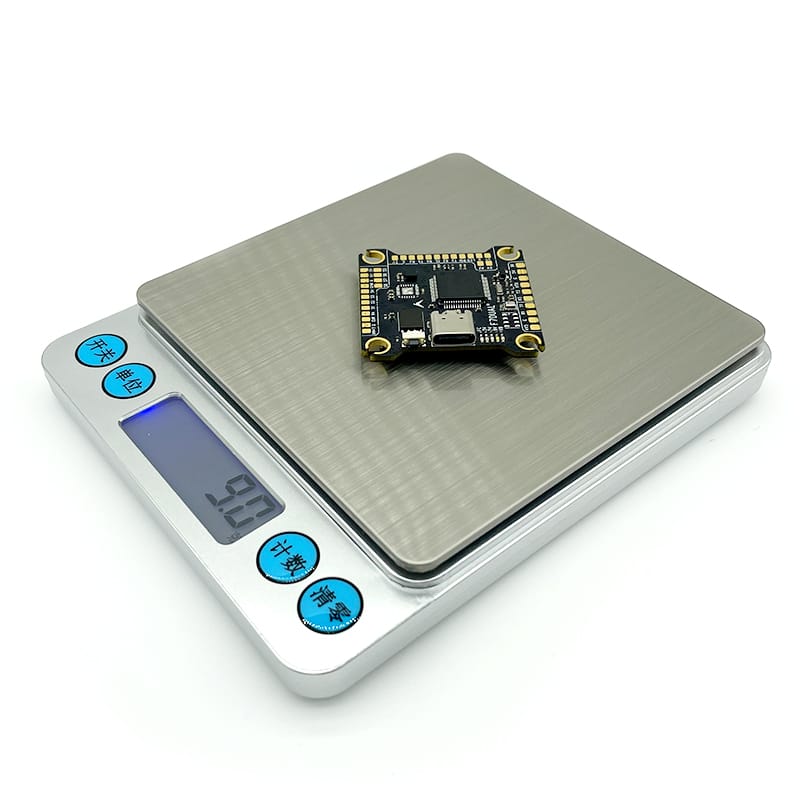
The D-F722 V1 flight controller is designed for pilots who need flexible connectivity, compact installation, and dependable control hardware in a racing drone. At its core, the board uses an STM32F722RET6 MCU and supports the F7DUAL firmware target. In addition, the design shown in the product documentation uses a BMI270 IMU, with MPU6000 and BMI270 options listed for configuration. Barometer support includes BMP280, DPS310, and MS5611 options. Therefore, builders can adapt the board to different multirotor layouts and flight-software requirements. The D-F722 V1 supports 3S to 6S LiPo power, covering an input range of 12V to 25.2V. Its onboard BEC outputs provide 5V/2.5A and 9V/3A power. As a result, compatible receivers, video equipment, and other electronics can receive dedicated regulated power. The 37mm x 37mm board uses a 30.5mm x 30.5mm mounting pattern and weighs 9.0g. That combination suits compact frames where every millimeter and gram matters. Moreover, five UARTs support receiver, VTX, ESC, and optional peripheral connections. The wiring documentation also shows support for GPS, LED strips, buzzers, analog FPV systems, DJI digital video equipment, and common receiver protocols such as SBUS, PPM, IBUS, CRSF, and ELRS. Finally, eight motor signal outputs make the board suitable for standard multirotors and X8 configurations.

D-F722 V1 Flight Controller Specifications
| Component | Specification |
|---|---|
| MCU | STM32F722RET6 |
| IMU | MPU6000 / BMI270 optional |
| Barometer | BMP280, DPS310, or MS5611 optional |
| Firmware target | F7DUAL |
| BlackBox | 16MB |
| Serial connectivity | Five UARTs |
| Motor outputs | Eight channels |
| Input voltage | 12V-25.2V, 3S-6S LiPo |
| BEC outputs | 5V/2.5A and 9V/3A |
| Dimensions | 37mm x 37mm |
| Mounting pattern | 30.5mm x 30.5mm |
| Weight | 9.0g |
The specification set is practical for both racing drone builds and broader multirotor projects. Specifically, the five UART assignments cover a receiver on UART1, optional equipment on UART2, VTX communication on UART3, ESC communication on UART4, and another optional device on UART5. Furthermore, the USB Type-C interface provides direct access to the board for setup and configuration.
Connectivity for FPV, GPS, and X8 Configurations
The D-F722 V1 flight controller is built around a clearly documented wiring system. For example, the board includes connections for analog cameras and VTX equipment, with camera wiring labeled for video, ground, and power. The illustrated camera module shows a 5V-36V power range. However, builders should verify the voltage requirements of their own hardware before connecting it. The diagram also shows support for an IRC-type VTX and a TBS Unify Nano VTX.
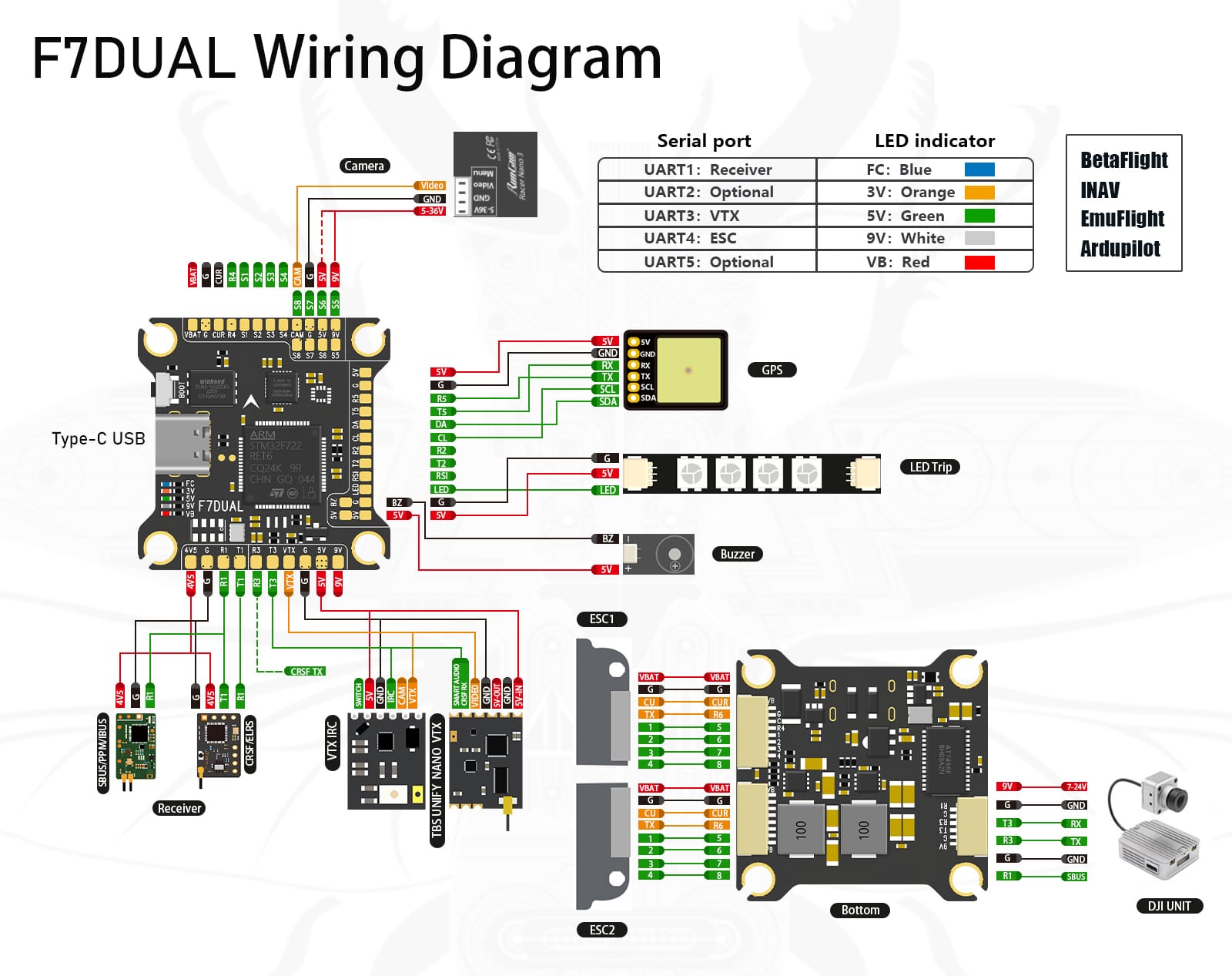
GPS integration is equally flexible. The dedicated connection provides 5V, ground, RX, TX, SCL, and SDA lines. Therefore, it can accommodate serial GPS communication alongside I2C compass wiring when supported by the selected module. Receiver examples include SBUS, PPM, IBUS, CRSF, and ELRS. Meanwhile, the DJI digital FPV wiring illustration routes 9V power to the digital unit, along with ground, UART3 communication, and UART1 SBUS connections. The diagram identifies a 7V-24V input range at the DJI unit.
- Connect receivers using several widely used RC protocols.
- Add GPS, compass, LED strips, and an external buzzer.
- Use dual ESC connectors with telemetry, current sensing, and motor signals.
- Drive motor outputs 1 through 8 for an X8 multirotor layout.
The dual ESC connectors add another useful advantage for advanced builds. They carry battery voltage, ground, current sensing, telemetry, and motor signal wiring. In addition, dedicated pads support an addressable LED strip and an external buzzer. Status LEDs identify the flight-controller rail, 3V, 5V, 9V, and battery voltage. As a result, builders get useful visual feedback while checking power and connections.
Compact Installation and Everyday Build Benefits
The board uses a compact square PCB with gold-colored solder pads, plated corner mounting slots, and white orientation arrows. Its 30.5mm mounting pattern follows a common stack format, so it can suit many compatible racing drone frames. At only 9.0g, the D-F722 V1 flight controller adds little weight to a performance-focused airframe. Nevertheless, always confirm frame clearance, connector orientation, and mounting hardware before installation.
The component side carries the STM32 controller, USB Type-C port, status LEDs, and labeled edge pads. On the reverse side, board-to-board connectors and two large gray inductors support the power and connection layout. Consequently, the design provides a useful balance between accessible wiring and a clean installation. Betaflight, INAV, and EmuFlight are listed as supported flight software, while the wiring documentation also references ArduPilot.
- Confirm the frame uses the 30.5mm x 30.5mm mounting pattern.
- Check the LiPo voltage and every peripheral’s power requirement.
- Assign UARTs according to the receiver, VTX, ESC, and GPS layout.
- Inspect LED indicators and wiring before applying battery power.